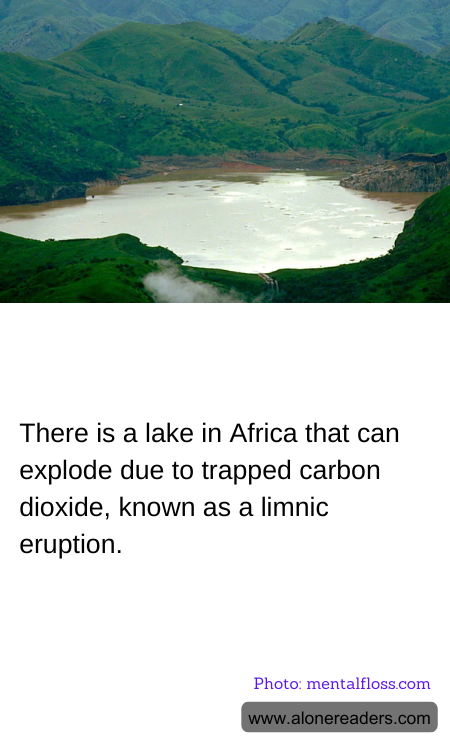
In Africa, one of the most intriguing and potentially deadly natural phenomena occurs in the form of limnic eruptions. These rare but catastrophic events happen in lakes where volcanic activity is present, leading to an accumulation of dissolved gases, primarily carbon dioxide, beneath the lake's surface. One of the most notable lakes where this phenomenon can occur is Lake Nyos in Cameroon, a crater lake situated in a dormant volcanic crater. Another similar lake is Lake Monoun, also in Cameroon.
A limnic eruption, often referred to as a lake overturn, occurs when the saturated CO2 gas suddenly releases from the lake water, creating a lethal gas explosion that can suffocate wildlife, livestock, and humans living nearby. The mechanism behind this violent release typically involves a disturbance in the lake's stratified waters, which can be triggered by factors such as a landslide, earthquake, or even a significant change in weather. Without these disturbances, the CO2 remains dissolved in the lower, colder layers of the lake due to the high pressure.
The most devastating occurrence of a limnic eruption was at Lake Nyos in 1986, when approximately 1.6 million tons of CO2 rapidly escaped from the lake, forming a gas cloud dense enough to hug the ground and valleys, displacing breathable air up to 25 kilometers away. The disaster claimed the lives of around 1,700 people and countless animals by asphyxiation. Following this tragic event, scientists have worked to develop methods to prevent such disasters in the future. One effective strategy has been the implementation of degassing tubes that slowly release the trapped gas from the lake to the atmosphere in a controlled manner, reducing the risk of accumulation and a subsequent eruption.
Understanding and monitoring of these unique lakes is crucial. Continuous research not only helps mitigate the risks associated with limnic eruptions but also contributes to our broader understanding of volcanic lakes and their behaviors worldwide. The case of lakes like Nyos and Monoun serves as a stark reminder of the dynamic and sometimes dangerous nature of our planet's geophysical processes.
