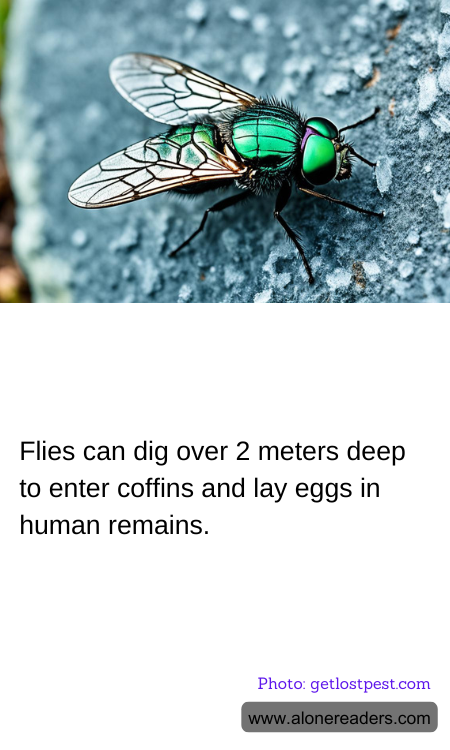
Flies are opportunistic scavengers and one of nature’s primary decomposers, playing a crucial role in the ecosystem by breaking down dead material. However, a common misconception is that they can dig over 2 meters deep to enter coffins and lay eggs in human remains. In reality, the scenario is quite different.
Most coffins are buried under at least 6 feet of soil, which is approximately 1.8 meters deep, often in cemeteries that follow regulations ensuring coffins are securely enclosed either in a vault or densely packed earth. This depth, combined with the compactness and composition of the soil, generally forms an effective barrier against most insects, including flies.
The ability of a fly to reach buried remains typically depends on the integrity of the coffin and the surrounding soil. In instances where graves are shallow, the soil is loosely packed, or a coffin deteriorates significantly over time, flies and other insects might find their way into the coffin. However, the notion of flies actively digging or burrowing through meters of tightly packed earth is biologically and physically unfounded.
Flies, especially blowflies, are attracted to decomposing organic matter where they can lay eggs, and their larvae, or maggots, can feed. What is plausible is that if there is any breach in a grave's protection — be it through natural decay or damage — scents emitted by decomposing bodies could attract flies to the site if the soil covering is not secure. Additionally, certain species of flies have remarkably acute senses and can detect the gases released by decomposition from great distances, drawn to any accessible remains near the surface.
To lay eggs directly on a body, flies generally need direct access, which is most feasible when remains are on or near the ground's surface, such as in the cases of mass graves, compromised burial sites, or exhumed remains.
Therefore, while flies are key players in decomposition and can contribute significantly to the breakdown of organic matter, their ability to dig through several meters of earth to reach a corpse is a myth. Proper burial practices effectively guard against such scenarios, ensuring that remains are left undisturbed and ecosystems continue to function with flies serving their ecological role without direct interaction with buried human remains.
