More About This Card
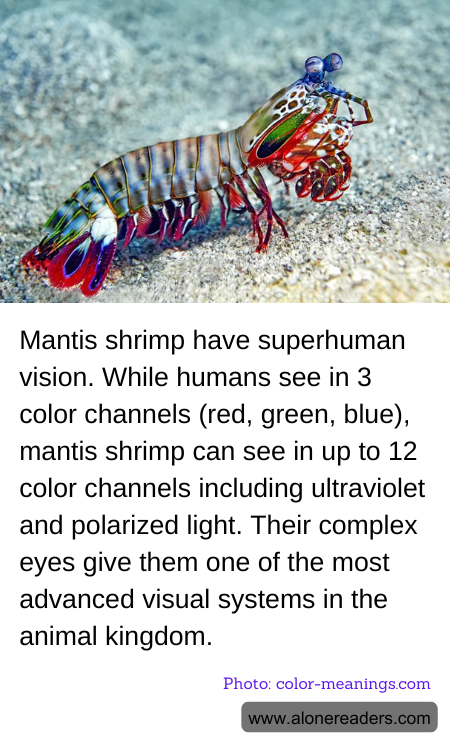
Mantis shrimp are among the most visually gifted creatures on Earth, possessing abilities far beyond the capacity of human vision. Unlike humans, who perceive the world through three primary color channels (red, green, and blue), mantis shrimp can discern an astonishing spectrum of colors through up to 12 different color channels. These channels include not only the visible spectrum seen by humans but also ultraviolet light and polarized light, which are invisible to the human eye.
The eyes of mantis shrimp are mounted on mobile stalks and can move independently of each other, giving them a nearly 360-degree field of vision. This ability is critical for their survival, as it allows them to detect predators and prey from almost any direction. The structure of their eyes is equally fascinating. Each eye is divided into three sections, allowing them to simultaneously track multiple objects while still analyzing the detailed aspects of their environment. This complex visual system enables the mantis shrimp to recognize different types of coral, prey species, and even distinguish between different individuals of the same species.
Furthermore, the mantis shrimp's ability to see polarized light provides them with another layer of visual information. This type of light, which occurs when light waves vibrate in a particular pattern, enhances their ability to detect transparent or shiny objects in the water, which might otherwise go unnoticed. The detection of ultraviolet light only broadens their visual capacity, enabling interactions with their environment in ways humans can hardly imagine.
The evolutionary development of such an elaborate visual system in mantis shrimp remains a subject of scientific inquiry. This exceptional visual capacity likely stems from the need to adapt to their complex, colorful, and competitive environments, where rapid and precise visual processing is essential for survival. Understanding how mantis shrimp process such an incredible amount of visual information not only sheds light on the mechanisms of vision itself but also has potential applications in technology, where humans could emulate their visual abilities in cameras and optical devices, advancing our own capacity for seeing the world.