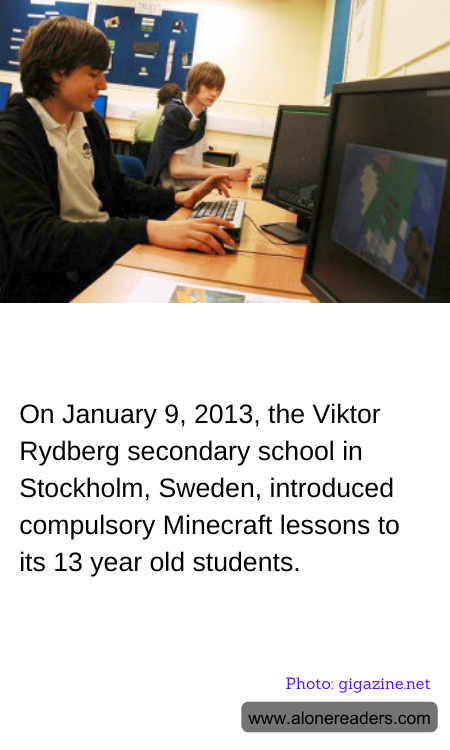
In an innovative educational move, the Viktor Rydberg secondary school in Stockholm, Sweden, introduced compulsory Minecraft lessons for its 13-year-old students on January 9, 2013. This forward-thinking approach aimed to harness the power of gaming in education, tapping into the immense popularity and engaging nature of Minecraft, a game known for its creative and building aspects. The school's decision emerged from the understanding that games like Minecraft could significantly enhance learning, fostering creativity, problem-solving skills, and teamwork among students.
Minecraft, a game that allows players to construct buildings and create environments in an open-world format using textured cubes, has often been noted for its educational potential. The game encourages players to engage in project-based learning and resource management, which are valuable skills in both academic and real-world scenarios. By integrating Minecraft into the curriculum, the Viktor Rydberg school sought not only to make learning more engaging but also to introduce a novel way to teach traditional subjects such as environmental issues and urban planning through an interactive platform.
Teachers at Viktor Rydberg reported that the inclusion of Minecraft in lessons had a positive impact, noting an increase in creativity and collaboration among students. The game's environment provided a safe space for experimenting with designs and problem-solving, with the immediate feedback built into the gaming experience aiding rapid iteration and improvement. Moreover, it allowed teachers to introduce complex concepts in a more accessible and relatable manner.
The success of the Minecraft-based lessons at Viktor Rydberg has been noted by educators worldwide, inspiring similar initiatives in other schools. It demonstrated the potential of using gaming technology to transform and enhance traditional educational methodologies, making them more applicable to the digital age. Schools adopting this method found that students were more motivated and engaged, which translated to an enhanced learning experience with potentially better outcomes in terms of student understanding and retention of information.
This model of incorporating popular video games into the educational process marks a significant shift in teaching strategies, reflecting a broader understanding of how digital tools can be aligned with educational goals to prepare students for a rapidly changing world. As educational institutions continue to explore and adapt to new ways of learning, the integration of video games in the curriculum could possibly become more widespread, influencing future educational practices on a global scale.
