More About This Card
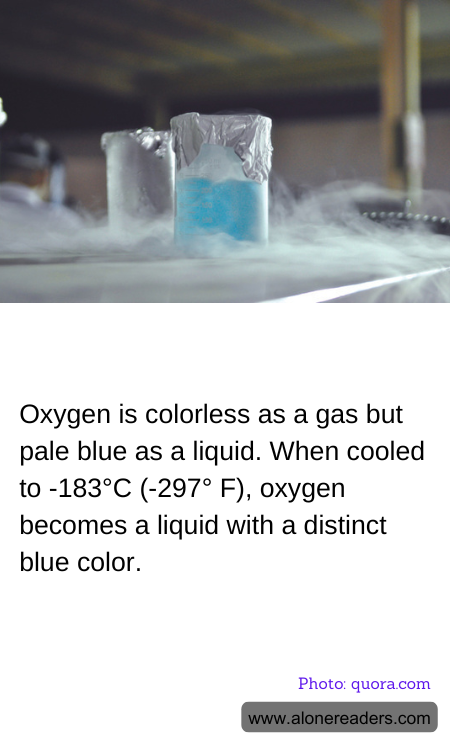
Oxygen, the life-sustaining component crucial for respiration in most terrestrial life forms, exists as a colorless gas at room temperature. However, when subjected to extremely low temperatures, specifically below -183°C (-297°F), its physical state transforms dramatically into a liquid, exhibiting a surprising pale blue hue. This shift not only marks a change in its physical appearance but also in the behavior and properties it exhibits under different conditions.
The pale blue color of liquid oxygen can be attributed to the absorption and scattering of light by the dense fluid. In its gaseous state, oxygen molecules are far apart, allowing light to pass through without much interference. However, once liquefied, the molecules are packed closely together, enhancing the interaction between light and the molecules of oxygen, which results in light absorption over a specific part of the spectrum, thus imparting a blue color.
This phenomenon is not just a curious visual feature but is also indicative of the underlying molecular behavior and the interactions within the substance. Such transformations are critical for various industrial applications, including the production of industrial gases and in the field of aerospace for rocket propulsion. The stark change from a colorless gas to a blue liquid also underscores the fascinating interplay of natural elements under different physical conditions, offering insights into their adaptive behaviors across states of matter. Liquid oxygen, despite its beauty, must be handled with extreme caution due to its highly reactive and oxidizing nature, which can intensify and support the combustion of other materials.
Understanding and observing the properties of oxygen in both its gas and liquid states are instrumental for scientific and practical applications. It reinforces the importance of state changes in elemental properties and offers a glimpse into the intriguing world of physical chemistry where even the air we breathe can surprise us with its hidden characteristics under altered conditions.