More About This Card
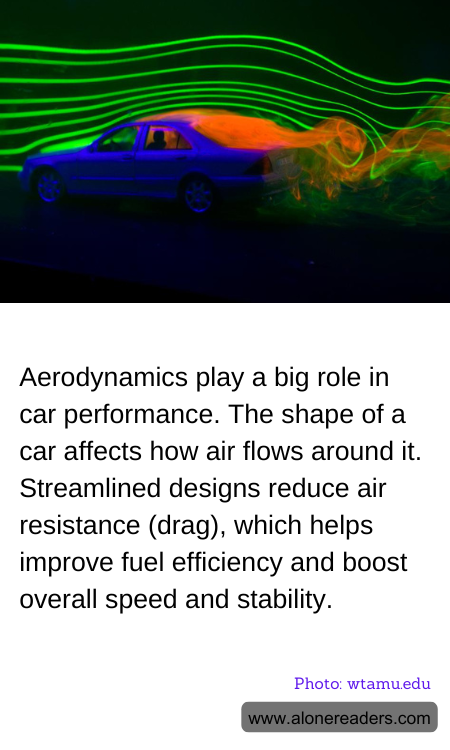
Aerodynamics is a crucial factor in modern automotive design, influencing not just a vehicle's efficiency but also its performance and handling. The science revolves around how air flows around a car's body, affecting drag, which is a force that opposes the vehicle’s motion through the air. High levels of drag can reduce a vehicle’s speed and increase its fuel consumption due to the increased effort required to push the car through the air.
Streamlined car designs reduce this drag, enhancing fuel efficiency by allowing the car to move more smoothly and quickly through the air. Such designs are characterized by smooth, rounded edges and a shape that tapers at the back, minimizing air disturbances and the vacuum effect that occurs behind the vehicle, which further pulls it back. This is particularly significant at higher speeds, where air resistance has a more pronounced impact on the car's performance.
Aerodynamic efficiency does not only contribute to lower fuel consumption and the ability to achieve higher speeds but also improves the vehicle’s stability. Proper airflow management can reduce lift, which tends to occur as a vehicle's speed increases, potentially leading to loss of traction particularly in lighter vehicles. Engineers employ various features such as spoilers, diffusers, and specially shaped mirrors to manage airflow and keep the vehicle stable at different speeds.
Automakers are constantly experimenting and innovating in the area of aerodynamics to create vehicles that are not only faster and more fuel-efficient but also safer and more comfortable to drive. Whether it’s in everyday passenger cars where efficiency is paramount or in high-performance sports cars where speed and handling are the focus, the principles of aerodynamics are extensively applied. The advancements in computational fluid dynamics (CFD) and wind tunnel testing have also significantly enhanced designers' ability to refine these aerodynamic properties more precisely.
Considering the global push for more eco-friendly transportation options, such as electric vehicles, the role of aerodynamics becomes even more prominent. Minimizing drag can help in extending the range that these vehicles can travel on a single charge, thereby making them more practical and appealing to consumers. Thus, as we move forward, the integration of advanced aerodynamic design continues to play a pivotal role in the evolution of automotive technology, shaping the future of transportation in terms of both performance and sustainability.