More About This Card
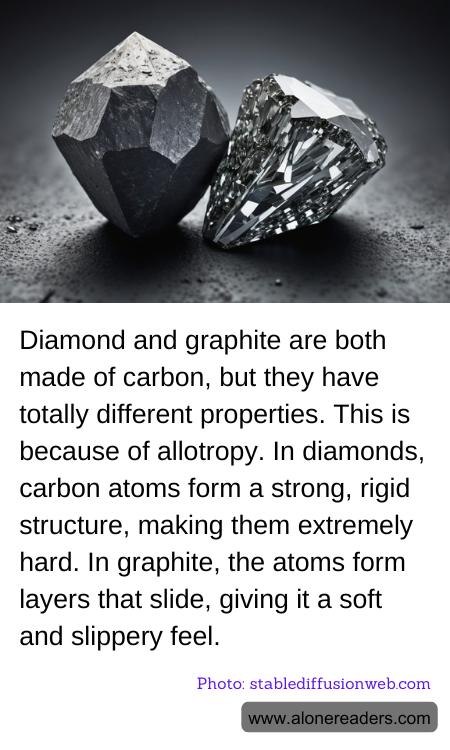
Diamond and graphite, despite both being composed entirely of carbon, exhibit remarkably different properties due to their distinct atomic structures—a phenomenon known as allotropy. Allotropy refers to the existence of two or more different physical forms of a chemical element within the same physical state.
The uniqueness of diamond lies in its crystal structure, where each carbon atom is tetrahedrally coordinated with four other carbon atoms. This specific arrangement forms a three-dimensional lattice that contributes to diamond’s renowned hardness, which makes it the hardest known natural material. This impressive hardness along with its high refractive index and dispersion of light, makes diamonds exceptionally useful not only as gemstones in jewelry but also in industrial applications where cutting, grinding, and drilling materials are required.
In contrast, the structure of graphite is composed of layers of carbon atoms arranged in a hexagonal lattice. Each atom in a layer is strongly bonded to three neighbors, but these layers are only loosely held together by weaker van der Waals forces. This allows them to slide over each other easily, giving graphite its characteristic slippery feel and excellent lubricating properties. Additionally, graphite is a good conductor of electricity, a property that diamond lacks, due to the movement of electrons within its layers.
These differing atomic arrangements in diamond and graphite not only explain their distinct physical properties but also underline the fascinating complexity of chemical elements, where mere changes in atomic bonding can lead to materials with vastly different characteristics. This versatility is further exploited technologically in various applications ranging from mechanical systems to electronics, demonstrating the broad implications of structural differences at the atomic level.