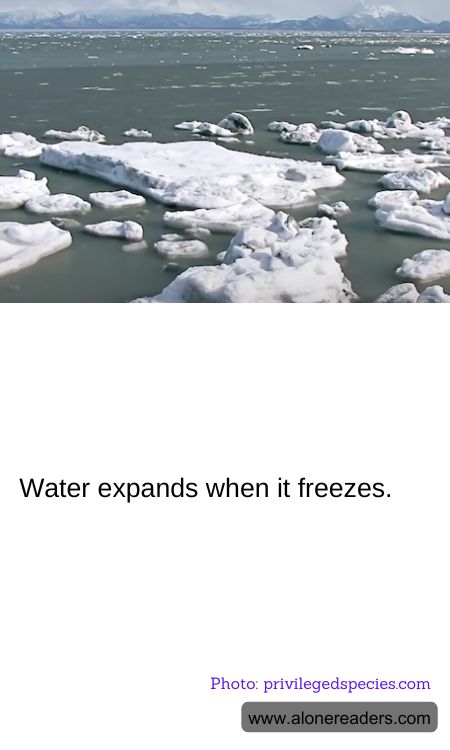
Water is a substance that exhibits a number of unique and fascinating properties, one of which is its ability to expand when it freezes. Unlike most other substances, water increases in volume as it transitions from a liquid to a solid state. This unusual behavior has significant implications for the natural world, as well as for human-made structures and systems.
The expansion of water occurs due to the molecular structure of ice. Water molecules are made up of two hydrogen atoms and one oxygen atom. When water is in its liquid form, these molecules are relatively free to move about and are fairly close to each other. However, as the temperature drops and water begins to freeze, the molecules start to arrange themselves in a rigid lattice that is held together by hydrogen bonds. This hexagonal lattice structure causes the molecules to be spaced further apart than in liquid water, thus increasing the volume of water as it turns into ice.
This expansion upon freezing is responsible for the phenomenon of ice floating on liquid water. Since ice is less dense than liquid water due to the increased volume, it floats. This peculiar property plays a crucial role in the survival of aquatic life during winter. As bodies of water freeze from the top down, ice forms on the surface while water below remains liquid, providing a habitat for aquatic organisms.
Moreover, the expansion of water upon freezing can have dramatic effects on the environment and human-made structures. In nature, this expansion can contribute to the weathering of rocks through a process known as frost wedging. Water that seeps into cracks and crevices in rocks will expand when it freezes, exerting pressure on the rock, eventually causing it to fracture and break apart.
For human-made structures, such as pipes and roads, the freezing and expanding water can cause significant damage. Water that freezes in pipes can lead to increased pressure, and in many cases, the pipes can burst, resulting in costly damages and the need for repairs. Similarly, the cycle of freezing and thawing can create potholes in roads, as water expands in cracks and spaces under the pavement.
Understanding the expansion of water when it freezes is not only important for scientific and engineering applications but also for everyday life, helping to mitigate risks associated with winter weather and freezing conditions. This knowledge is fundamental in fields ranging from environmental science to civil engineering, influencing how we design infrastructure and manage natural resources.
