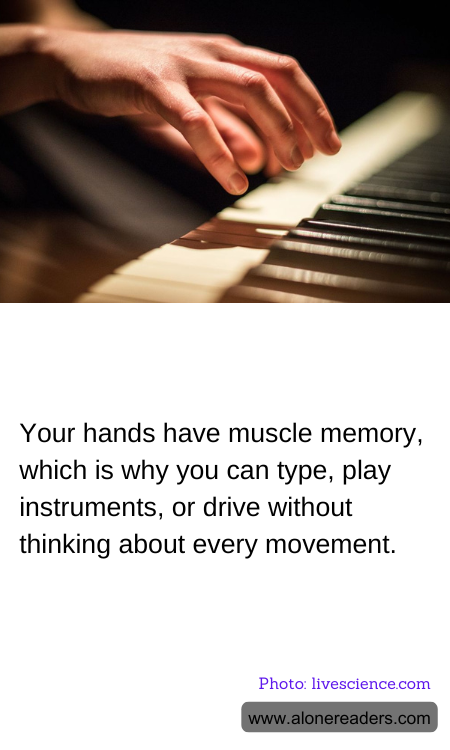
Muscle memory, a form of procedural memory, plays a crucial role in performing activities that require physical coordination and timing, such as typing, playing musical instruments, and driving. This type of memory allows our muscles to essentially "remember" certain actions through repetition. When you first learn a task, like playing a piano or typing on a keyboard, your conscious mind and motor skills are heavily engaged. You have to think about every little movement, which can be slow and error-prone.
However, with practice, these actions become more automatic and require less conscious thought. This transformation owes to the plasticity of our brains—the ability to adapt and change with experience. In terms of neural mechanics, what happens is that the neural pathways involved in executing these movements become more efficient. Each time you repeat the task, the connections between neurons in the relevant motor circuits strengthen, and the amount of mental effort needed decreases.
This shift from deliberate, attentive management of movements to effortless execution is what we refer to as muscle memory taking over. It’s not that muscles themselves have memory; rather, the brain develops a sort of shorthand for executing frequent tasks. Once established, these motor sequences can be triggered with minimal conscious input, allowing for swift and smooth execution. This explains why a pianist can perform complex compositions without seemingly looking at the keys or why you can type on your keyboard without constantly glancing down to find the right letters.
The development of muscle memory is beneficial not just in mastering specific skills but also in our daily lives, freeing up cognitive resources for other tasks. This efficiency typically results from considerable practice and repetition, highlighting the importance of consistent and repeated practice when learning a new skill. Furthermore, muscle memory is incredibly durable. Once these motor sequences are ingrained, they are usually retained for many years, even with minimal use. For example, it's often observed that once you learn how to ride a bicycle, you never really forget it.
In essence, the phenomenon of muscle memory is a powerful testament to our brain's adaptability and capability to automate complex sequences of actions, improving both our skills and our ability to multitask. This not only enhances our ability to perform specific skilled tasks but also affects our efficiency and competency in everyday life.
