More About This Card
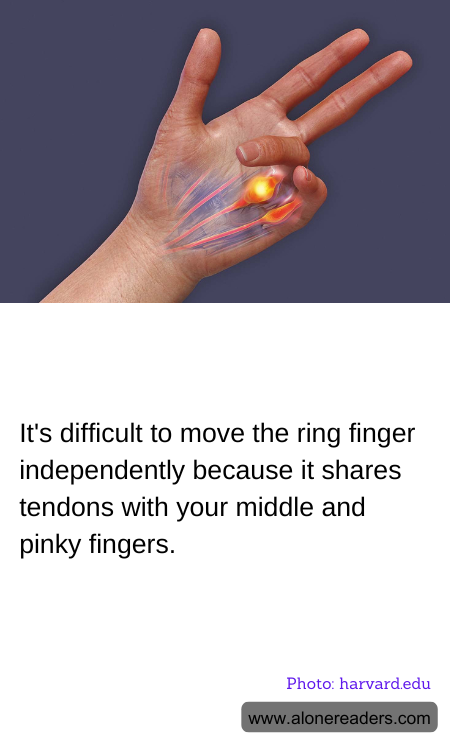
The ring finger's limited independent movement can indeed pose a challenge for many individuals. This limitation primarily stems from the anatomical structure of the hand, specifically the arrangement and sharing of the flexor tendons and the intricate network of muscles controlling these digits. The flexor tendons, which are responsible for curling the fingers, are not as distinctly separated for the ring finger as they are for the others. Consequently, when you attempt to move your ring finger, you might notice that your middle or pinky fingers are also inclined to move.
This phenomenon results from the way the hand's muscles and tendons are designed. The human hand has three types of muscles: intrinsic, which are located within the hand itself, and extrinsic, which are located in the forearm and attach to the fingers via tendons. The tendons that control the ring finger, particularly the flexor digitorum superficialis and the flexor digitorum profundus, are interconnected with those of the other fingers. The former tendon helps to bend the finger at its middle joint, while the latter bends it at the tip. Because these tendons are shared, particularly between the middle, ring, and pinky fingers, the neurological and physical command for isolating the ring finger movement is more challenging.
Furthermore, the movement of the fingers is also controlled by the brain and the specific way it sends signals through the nerves to the muscles of the hand. The cerebral cortex, which plays a crucial role in movement and coordination, might not distinctly differentiate the ring finger as much as it does the thumb or index finger. These fingers are typically more responsive to individual commands due to their role in precision grips and other fine motor skills, which are essential for various daily tasks and evolutionary functions.
Despite these challenges, it's possible to increase the independence of the ring finger through exercises and regular practice. Musicians, particularly pianists and guitarists, often engage in such practices to enhance their finger independence and dexterity. These exercises usually involve pressing the fingers down on a flat surface or using devices like grip strengtheners while trying to lift only the ring finger repeatedly. Over time, such exercises can lead to slight improvements in the finger's independence, although it's generally accepted that it will not reach the same level of autonomy as the thumb or index finger.