More About This Card
In the complex and highly organized society of honeybees, the queen plays a pivotal role, particularly in the domain of reproduction. The queen bee, a single reproductive female in the hive, has a fascinating mating behavior that is crucial for the survival and genetic diversity of her colony. Typically, a young queen will embark on a series of mating flights shortly after reaching maturity. These flights, which usually occur within the first few weeks of her life, are the only times the queen bee will mate.
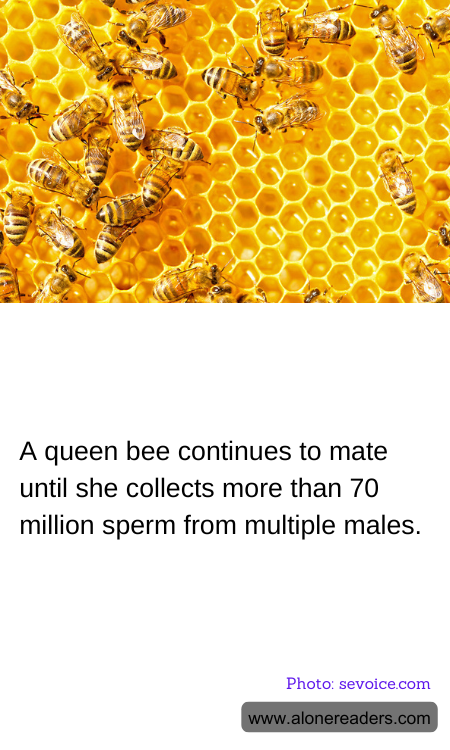
During these flights, the queen bee will mate with multiple drones (male bees), and it is not uncommon for her to mate with more than a dozen different males. This polyandrous behavior is strategic, enhancing the genetic diversity of the offspring, which is vital for the colony's resilience to diseases and environmental challenges. The process takes place in mid-air, often hundreds of meters above the ground, where the queen stores the sperm from these multiple mates in her spermatheca, a specialized organ that can hold over 70 million sperm cells.
The queen's ability to store such a vast quantity of sperm is critical as it enables her to lay fertilized eggs throughout her life without needing to mate again. She selectively releases sperm from her spermatheca as and when she lays eggs, which can number up to 2000 a day during peak season. This remarkable efficiency is significant for the perpetual growth and sustenance of the colony.
Interestingly, the drones, after mating, fulfill their role in the reproductive cycle and die shortly after, as their primary function is to provide sperm for the queen. The success and continuity of the entire colony rest largely upon the queen's ability to successfully mate and store adequate sperm. Her health and longevity directly influence the hive's productivity and survival, making her arguably the most critical member of her bee community.
This mating strategy also involves significant risks, with the queen being vulnerable to predators and adverse weather conditions during her mating flights. However, these risks are offset by the immense benefits of genetic diversity and colony robustness provided by the queen's ability to mate with multiple drones and store a vast quantity of sperm, ensuring her hive's prosperity and continuation. Indeed, the queen bee’s reproductive capabilities are a marvel of nature, reflecting a sophisticated evolutionary strategy that supports the complex social structure and efficiency of bee colonies.