More About This Card
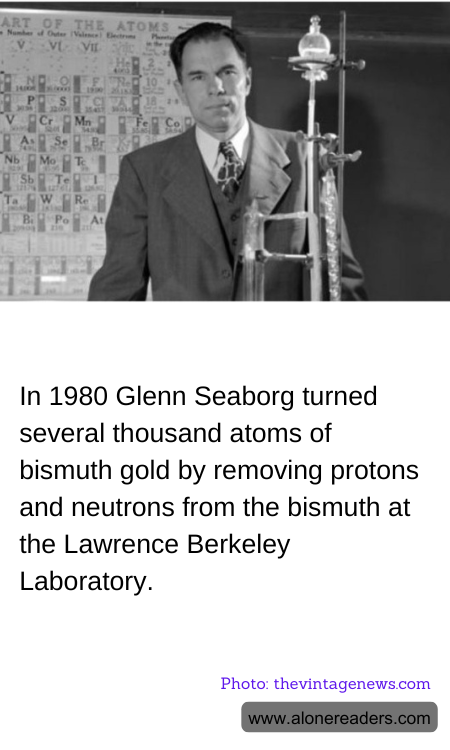
In 1980, a remarkable transformation took place at the Lawrence Berkeley Laboratory, where Glenn Seaborg, an eminent American chemist and Nobel laureate, was involved in groundbreaking research. Seaborg and his team managed to convert a small quantity of bismuth into gold. This alchemical-like feat was achieved by manipulating the atomic structure of bismuth through the removal of protons and neutrons.
Bismuth, which is element 83 on the periodic table, was carefully altered to decrease its atomic number to 79, thus transforming it into gold. The process, known as nuclear transmutation, involved a sophisticated use of particle accelerators, which are capable of changing the compositions of elements at the atomic level. In this particular experiment, the team directed a beam of charged particles at bismith atoms with enough precision and energy to knock off the necessary subatomic particles.
Although the conversion was scientifically successful, the amount of gold created was minuscule and the cost vastly exceeded the value of the gold produced. The experiment primarily served as a proof of concept and a vivid demonstration of the principles of nuclear physics rather than a practical method for gold production.
The experiment did, however, bolster our understanding of nuclear reactions and transmutations, showcasing the ability to change one element into another—a process that occurs naturally in stellar environments but is complex and resource-intensive to replicate on Earth. This type of research provides valuable insights into the structure of atoms and the forces that bind nuclear particles, contributing to various fields including nuclear energy production and radioactive waste management. Seaborg's experiment is a testament to the incredible advancements in chemistry and physics during the 20th century, highlighting both human ingenuity and the endless quest for scientific discovery.