More About This Card
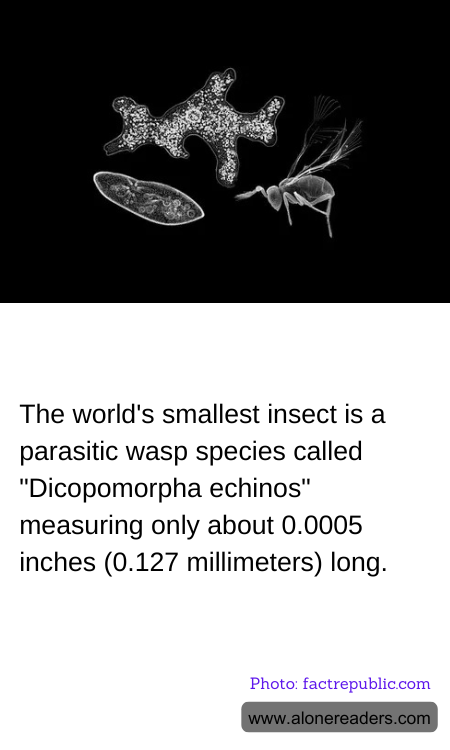
Dicopomorpha echmei, a species of parasitic wasp, holds the title for the smallest insect in the world. This minuscule creature measures a mere 0.0005 inches (0.127 millimeters) in length, making it barely visible to the naked eye. Native to the United States, these wasps exhibit fascinating and unique biological characteristics due to their incredibly small size.
Dicopomorpha echmei predominantly thrives in the eggs of other insects, where it leads a parasitic lifestyle. This microscopic wasp is an example of extreme miniaturization, which has prompted curiosity and study regarding how such tiny creatures manage vital physiological functions. One of the most remarkable features of D. echmei is the males' lack of wings coupled with highly reduced eyes that are almost non-functional. Despite these limitations, they manage to survive as internal parasites during their larval stage.
The female Dicopomorpha echmei, however, does possess the ability to fly, though they, too, are extremely small. Their primary role revolves around dispersing to find suitable host eggs in which to lay their own eggs. The evolutionary adaptations seen in D. echmei highlight a significant example of how lifeforms can specialize and thrive within a specific niche, no matter how small.
Understanding creatures like Dicopomorpha echmei is crucial not just for biological curiosity but also for studying ecosystems and the intricate ways organisms interact within them. The survival tactics and reproductive strategies of these minuscule wasps could unlock new insights into the fields of genetics, evolutionary biology, and even robotics, potentially inspiring new technologies engineered at similarly diminutive scales. The ongoing study of D. echmei and other tiny creatures continues to challenge our understanding of the limits of life's structural and functional adaptability.