More About This Card
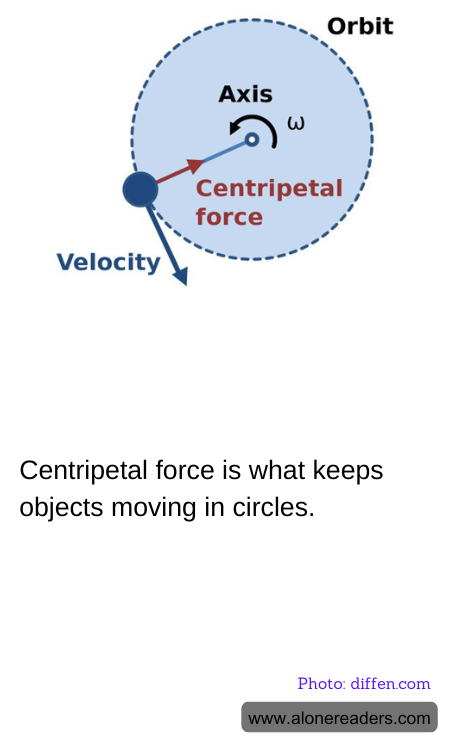
Centripetal force is an essential concept in physics, particularly when it comes to understanding circular motion. The term "centripetal" translates to "center-seeking" in Latin, which is a fitting description because it refers to the force that is necessary to keep an object moving in a curved path or circular orbit, directed towards the center of the circle or path. This force is crucial in preventing the object from continuing in a straight line due to inertia as described by Newton's first law of motion.
In everyday life, centripetal force is at play in various scenarios. For example, when a car makes a turn, the friction between the tires and the road provides the centripetal force that keeps the car on its curved path. Without this force, the vehicle would continue moving in a straight line, veering off the road. Similarly, when a person swings a bucket filled with water in a circular motion, the tension in the handle of the bucket provides the necessary centripetal force to keep the water from spilling out.
Centripetal force is not a type of force in itself, but rather it is the resultant force acting towards the center caused by one or more other forces. This force can be provided by gravity, tension, friction, or any other of a number of forces depending on the situation. For instance, the gravitational pull of the sun provides the centripetal force that keeps the planets in their orbits.
The formula to calculate the magnitude of this force is F = mv²/r, where m is the mass of the object, v is the velocity at which the object is moving, and r is the radius of the circular path. This equation shows that the force needed increases with the square of the velocity, meaning that an object moving faster needs a much stronger force to continue moving in a circle than an object moving slowly.
Centripetal force plays a pivotal role in fields like astronomy, engineering, and many aspects of daily life. It allows roller coasters to make safe loops, helps astronomers understand the orbits of celestial bodies, and shapes the designs of roads and tracks to accommodate safe travel. Understanding how this force works gives insight into why planets don’t just fling out into space, why cars don’t skid on curvy roads under normal conditions, and why the intense speeds of roller coasters don’t send the cars flying off the tracks. Thus, centripetal force is not merely a concept confined to textbooks; it's a fundamental aspect of the dynamics of rotational movements we observe and experience regularly.