More About This Card
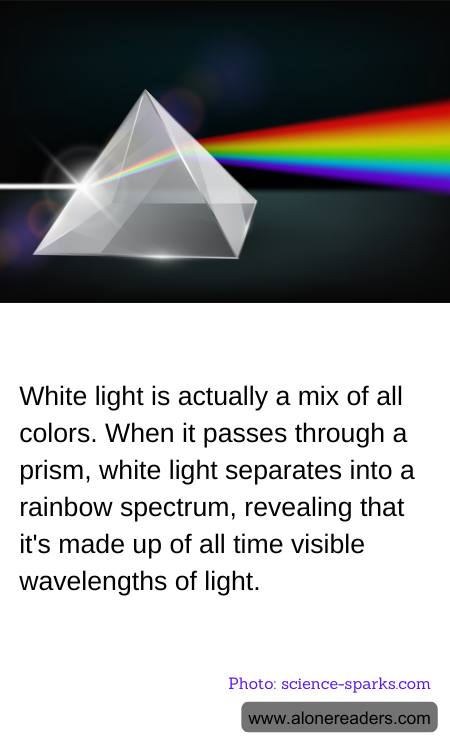
White light, often perceived as colorless or simply "white," is in fact a composite of all visible colors of light. This everyday phenomenon becomes strikingly evident when white light passes through a prism, a process known as dispersion. A prism, typically a triangular-shaped glass or crystal, bends the light passing through it—a process dictated by the differing wavelengths of the various colors that make up white light.
Each color in the visible spectrum possesses a distinct wavelength; red light has the longest wavelength and violet the shortest. When white light hits a prism, each component color is refracted at a slightly different angle depending on its wavelength. Red light bends the least, while violet bends the most. This spreading of light into a spectrum of colors creates a rainbow effect. The colors visible are the same sequence appearing in a natural rainbow—red, orange, yellow, green, blue, indigo, and violet, often remembered by the acronym ROYGBIV.
The separation of white light into its constituent colors not only provides a beautiful visual experience but also serves as a foundational principle in the field of optics. This principle is crucial in a variety of applications, from the analysis of celestial objects to the understanding of optical phenomena in the atmosphere, such as rainbows and halos around the sun or moon. Spectroscopy, a technique that analyzes the wavelengths of light emitted or absorbed by materials, relies on this dispersion to identify substances and study their properties.
Moreover, this dispersion principle helps in understanding more about the nature of light itself and has led to significant discoveries in both physics and astronomy. For instance, by studying the spectrum of light from stars and other celestial bodies, astronomers can determine their compositions, temperatures, and movements. This analysis, rooted in the basic principle observed with a simple prism experiment, underscores the complex and colorful nature of what might otherwise be mistaken for simple white light.