More About This Card
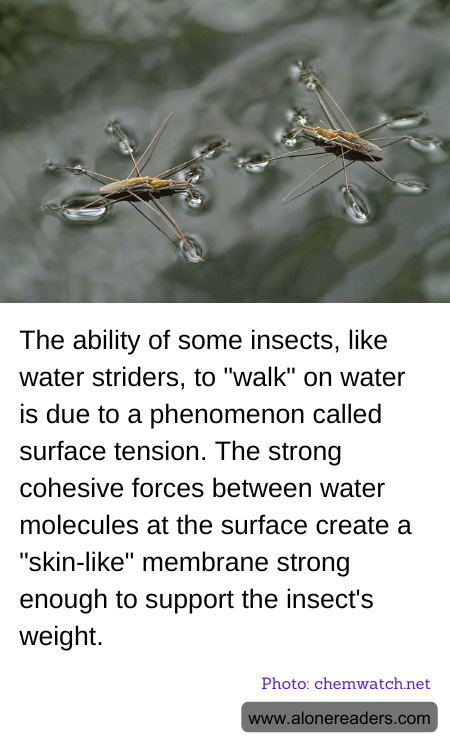
The mesmerizing ability of certain insects, such as water striders, to glide effortlessly across the surface of water is a fascinating example of nature’s ingenuity. This phenomenon is attributed primarily to surface tension, a physical property arising from the cohesive forces between liquid molecules, particularly at the liquid’s surface. The molecules at the surface of water are not surrounded by similar molecules on all sides, leading them to cohere more strongly to those directly associated with them on the surface. This creates a skin-like layer atop the water that is capable of resisting external force, enabling lightweight creatures to walk on it without breaking through.
Surface tension is essentially a measure of the strength of the water’s surface film. It acts like an elastic membrane capable of supporting weights that are relatively light in comparison to the strength of the tension. Water striders exploit this feature through their highly adapted legs which distribute their weight evenly over a larger area, reducing the force on any single point of the water’s surface. Each leg is equipped with tiny hairs that repel water and capture air, enhancing buoyancy and preventing the leg from sinking.
Interestingly, the ability to maneuver on the surface of water without submerging offers these insects a significant evolutionary advantage. It provides water striders access to food sources on the water surface, such as mosquitoes and other insects, while also allowing them to escape from predators.
Understanding how water striders and other similar insects utilize surface tension has inspired technological innovations, including the development of robots that can mimic this ability to move on water surfaces for environmental monitoring and other applications. This fascinating blend of biology and physics not only highlights the intricate adaptations of creatures to their environments but also showcases how insights from nature can lead to advancements in science and technology.