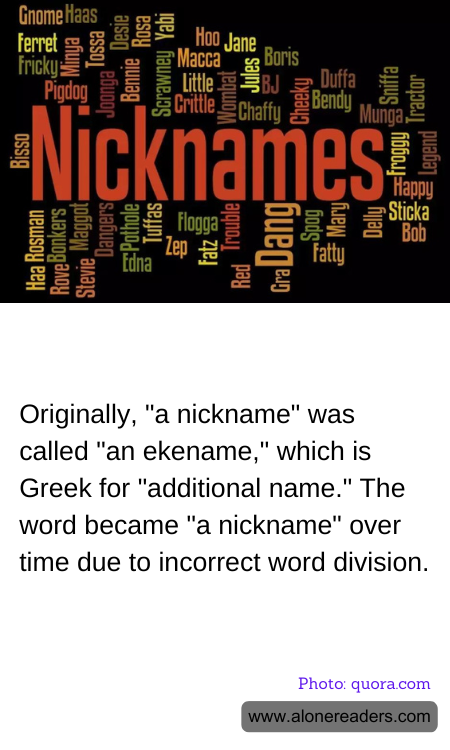
The evolution of the word "nickname" from "an ekename" is a fascinating example of how language changes over time due to the phenomenon known as metanalysis, or the incorrect division of words. "An ekename," which originally meant "additional name," traces its roots back to the Old English phrase where "eke" meant "also" or "additional," and "name" meant just that, a name. The term "ekename" was commonly used to denote a secondary or supplementary name given to a person, often describing an attribute or characteristic.
Over time, as the phrase "an ekename" was spoken rapidly in conversation, the boundary between "an" and "ekename" began to blur. This led to the misinterpretation of the phrase's structure. Instead of hearing "an ekename," people began to hear "a nekename." This shift, while subtle, had a significant impact on the word's construction. Eventually, "a nekename" transformed into "a nickname," which is the term we use today.
This process of word alteration is not unique to the term nickname. It reflects a broader linguistic trend where spoken language plays a key role in shaping the evolution of words, influenced by the way words are segmented and restructured over time. Thus, what started as "an additional name" in Old English not only shifted in its structure but also slightly in its usage, as today a nickname often refers more specifically to a familiar or humorous name given to someone instead of just any supplementary name. Such transformations in language highlight the dynamic and fluid nature of linguistic development and how historical linguistics can provide insights into the origins and changes in the words we use today.
