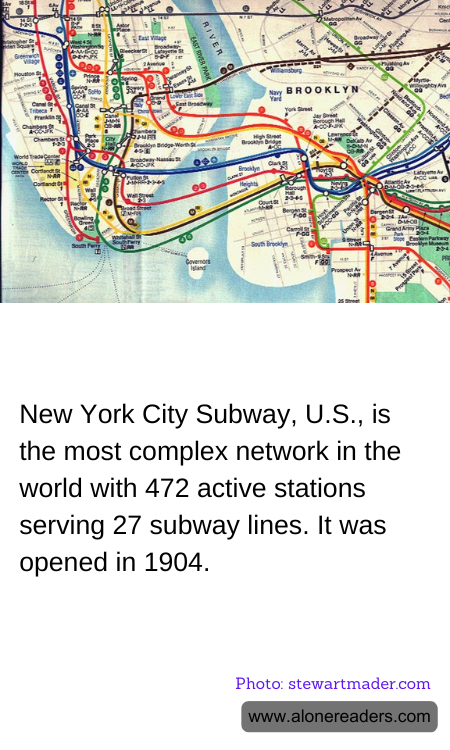
The New York City Subway, recognized as one of the most expansive and intricate public transit systems globally, serves as a vital artery in the urban fabric of New York City. Since its inception in 1904, the subway has grown significantly, now boasting 472 active stations across 27 different subway lines. This makes it the largest metro system in the world by the number of stations and one of the longest by route length.
The system's complexity isn't just in its sheer size but also in its operation and management. Operating 24 hours a day and 365 days a year, the subway provides resilient service to millions of passengers weekly. This round-the-clock operation is crucial in a city that famously never sleeps, supporting both the bustling economy and the vibrant cultural life of New York City.
One of the remarkable aspects of the NYC Subway is its role in popular culture and its ability to maintain historical character while continuously evolving with technological advancements. The stations themselves, many adorned with distinctive tile mosaics and architectural features, offer a glimpse into New York's rich historical tapestry. At the same time, efforts to modernize the system with digital signage, Wi-Fi access, and contactless payment systems reveal a commitment to enhancing commuter convenience and operational efficiency.
Moreover, the network's design facilitates comprehensive coverage, connecting distant neighborhoods to the economic, cultural, and social hubs of the city. This inclusivity fosters not only convenience but also economic opportunities for many New Yorkers. The connectivity reduces travel time and cost, which is indispensable in a city where time is as valuable as space.
Despite its benefits, managing such a vast network is not without challenges. Issues such as maintenance, service delays, and infrastructure aging are perennial concerns. Additionally, ensuring passenger safety in such a massive and densely utilized space is a continual priority, necessitating significant investment and strategic planning.
As New York City continues to grow and evolve, the subway system will undoubtedly play a critical role in shaping its future, just as it has shaped the city’s past. Balancing historical preservation with modernization, enhancing service reliability, and expanding to meet the needs of a growing population are key to maintaining the system’s status as a world-class transit system. The NYC Subway, with its complexity and extensive reach, remains a symbol of New York’s dynamism and its enduring ambition to connect and integrate its diverse communities.
