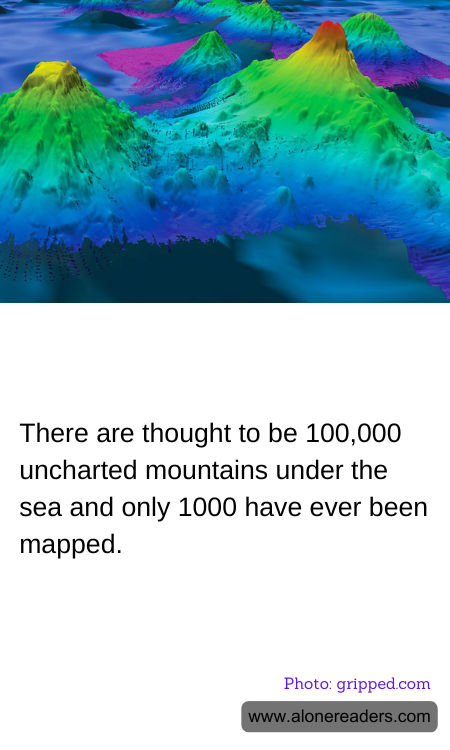
The ocean floor is home to an astonishing and largely unexplored terrain, including an estimated 100,000 seamounts—submerged mountains that rise from the ocean floor but do not reach the surface. These underwater mountains form through various geological processes, most commonly through volcanic activity. Despite their abundance, our knowledge of these submerged features is minimal; to date, only about 1,000 have been thoroughly mapped. This gap in knowledge underscores a significant challenge in oceanography and highlights the limitations of current technologies used in deep-sea exploration.
The mapping of these underwater mountains is no small feat. It requires advanced technology, such as multibeam sonar, which sends out sound waves to bounce off the sea floor. The data collected from the returning sound waves help scientists create detailed maps that depict the structure of the seafloor. This process, however, is time-consuming and costly, which explains why so little of the sea floor has been mapped compared to the Earth's land surfaces.
Understanding the contours of these submerged mountains is crucial for multiple reasons. Biologically, seamounts are biodiversity hotspots. They provide habitats for numerous marine species, including some that are not found anywhere else on Earth. Certain species depend on the unique environments created by underwater mountains, such as their current patterns and nutrient availability, to survive and thrive. From a geological standpoint, seamounts can offer insights into the processes that shape our planet, including the dynamics of tectonic plates and volcanic activity.
In addition, accurately mapping these features is essential for navigation and submarine cable routing. It's also vital for resource management and environmental conservation, as seamounts are often centers for deep-sea mining and fishing activities. The preservation of their rich ecosystems requires detailed knowledge of their locations and structures.
Future efforts to explore and chart these submerged mountains will depend heavily on advancements in underwater technology and increased funding for oceanographic research. As we continue to explore these hidden features of our planet, we can expect to uncover new species, new resources, and new information that could have significant implications for science and our understanding of the natural world. The vast uncharted territories under the sea hold secrets that are, as of yet, beyond our widest imaginations.
