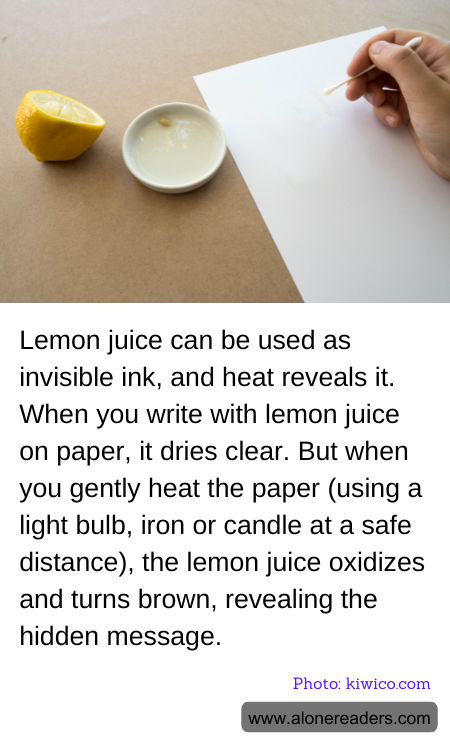
Lemon juice has long been recognized as a simple but effective form of invisible ink. The process of using lemon juice to write secret messages is both fun and accessible, making it a popular choice for children's science experiments and amateur sleuths alike. The science behind it is straightforward: lemon juice, which is primarily composed of citric acid, acts as a weak acid and alters the fibers of the paper where it's applied. When the paper is exposed to heat, the altered fibers react differently than the rest of the paper, usually browning or turning yellow first.
To create your own invisible messages with lemon juice, you begin by squeezing a lemon and straining out the pulp to obtain the juice. A cotton swab, toothpick, or fine brush can be used to write on any ordinary piece of paper. Once the juice dries, it becomes nearly invisible, leaving only the faintest hint of a glossy residue if inspected closely.
Revealing the message is where the magic happens. Applying a gentle heat source, such as a light bulb, a hair dryer set on low, or an iron (carefully handled to avoid scorching the paper), will cause a chemical reaction. As you heat the paper, the citric acid in the lemon juice slowly oxidizes and turns brown. This process can be quite delicate as overheating can cause the entire paper to burn or turn yellow, obscuring the message.
Using lemon juice as invisible ink is safe, non-toxic, and only requires household items, which contributes to its popularity. However, it’s worth noting that messages written in lemon juice are not the most secure form of communication. They can be easily revealed by anyone who suspects the presence of an invisible message and has access to a heat source. Therefore, while it’s perfect for fun educational activities or games, it wouldn't be suitable for sending sensitive information.
This intriguing use of lemon juice is a perfect example of how everyday substances can possess unique and unexpected properties, blending the worlds of science and creativity. It invites exploration and experimentation, often serving as one of the first entry points for many into the fascinating world of chemistry and secret codes.
