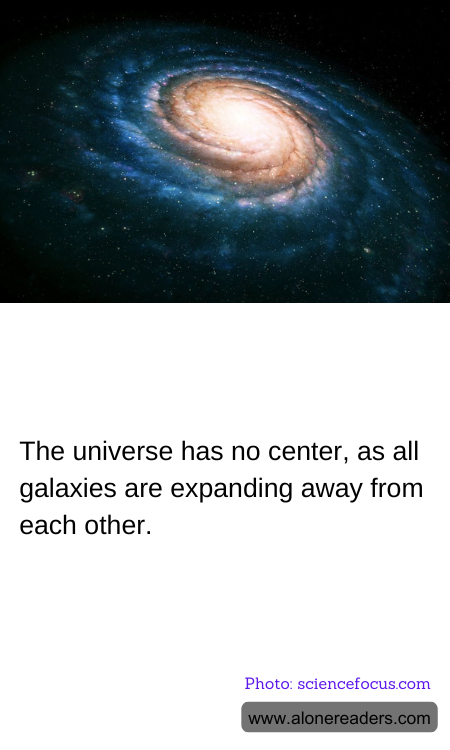
In our understanding of the cosmos, one of the most intriguing aspects is the uniform expansion of the universe. This expansion suggests that, contrary to what one might expect, the universe does not have a fixed center from which everything is expanding outward. Instead, every part of the universe is expanding, and this expansion is occurring equally at all points. The analogy often used to explain this concept involves imagining the universe like a balloon with dots on its surface. As the balloon inflates, each dot moves away from every other dot, and there is no central point on the surface of the balloon itself from which the expansion originates.
This idea stems from the observation that galaxies are moving away from us in every direction, which was first noted by Edwin Hubble in 1929. Through his observations, Hubble discovered that not only are galaxies moving away from us, but their speed of recession is proportional to their distance from us—the farther they are, the faster they are moving away. This relationship is encapsulated in Hubble’s Law, a cornerstone of cosmological theory.
This expansion of the universe is thought to have begun with the Big Bang, an event that occurred approximately 13.8 billion years ago. According to this theory, the universe was once concentrated into a very small, dense point, which then began expanding rapidly in a hot explosion. This expansion has continued ever since, with galaxies moving away from each other as the space between them stretches.
The concept that the universe lacks a center can be counterintuitive. If the universe is expanding, it's natural to think of it as expanding from a specific central point. However, because the universe was, according to current cosmological theories, uniformly dense at the time of the Big Bang, there is no singular place that can be considered the center. Instead, every point in the universe can be considered the center from its own perspective, as it sees other galaxies moving away from it.
This framework helps us understand not only the large-scale structure of the universe but also provides a crucial insight into how the universe has evolved over time. The continuing study of galaxy movements, cosmic microwave background radiation, and other phenomena provide us with valuable information about the origin, evolution, and eventual fate of the universe, helping us to construct a comprehensive picture of our cosmos in the absence of a central point.
