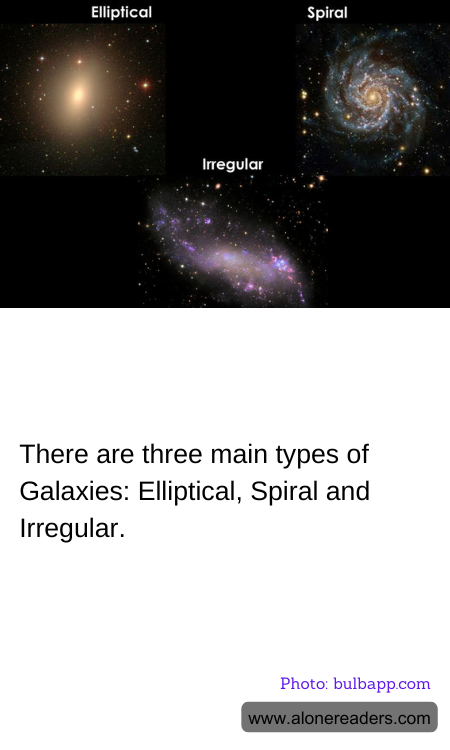
Galaxies, the vast islands of stars and other celestial matter, are categorized primarily into three main types based on their appearance and structure: elliptical, spiral, and irregular. Each type offers a unique glimpse into the processes governing the universe's evolution and showcases the diversity of structures that can form from the gravitational collapse of matter in the early universe.
Elliptical galaxies are characterized by their elliptical, or elongated, rounded shapes. They typically lack the presence of significant amounts of interstellar gas and dust and do not have the well-defined structure seen in other types of galaxies. Ellipticals range from nearly spherical (E0) to highly elongated (E7) and are generally composed of older, redder stars, suggesting that these galaxies have undergone most of their star formation earlier in their history. The size of elliptical galaxies can vary widely, from giant ellipticals many times larger than the Milky Way to smaller dwarf ellipticals.
Spiral galaxies, perhaps the most picturesque of the galaxy types, feature rotating disks of stars and dust, with prominent spiral arms extending from the center to the outskirts. These arms are sites of intense star formation and are brighter than the surrounding disc because of the young, hot stars they typically contain. The Milky Way, where our own solar system resides, is a classic example of a spiral galaxy. Spirals are further divided into subclasses based on the tightness of their spirals and the size of their central bulge: from Sa (with tight spirals and larger bulges) to Sc (with looser spirals and smaller bulges). There's also the barred spiral category (SB), where a bar of stars cuts across the nucleus, with spirals unwinding from the ends of the bar.
Irregular galaxies, as the name suggests, lack a distinct regular shape unlike the predictable forms of spiral and elliptical galaxies. They are often chaotic in appearance, with neither a central bulge nor any trace of spiral arm structure. Irregular galaxies are typically rich in gas and dust, making them fertile grounds for new stars. These galaxies are thought to be either in the process of formation or heavily disturbed by external forces, such as gravitational interactions with other galaxies. Irregulars can be further classified into two types: Irr I (which are somewhat more structured and may show hints of previous spiral or elliptical nature) and Irr II (which are completely chaotic in structure).
Understanding these fundamental types helps astronomers trace the evolutionary paths of galaxies, from their formation and growth through interactions or mergers and finally their senescence as star formation slows. Each type also provides clues about the distribution of dark matter, the role of black holes in galactic centers, and the conditions of the early universe, presenting an interconnected story of cosmic evolution.
