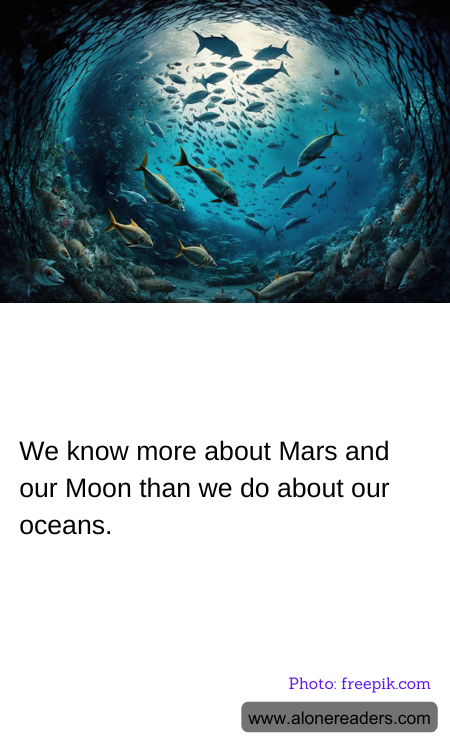
The vastness and complexity of Earth’s oceans continue to be a significant frontier in scientific exploration. Despite our proximity to them, the oceans remain less understood than celestial bodies such as Mars or the Moon. This paradox can be attributed to several factors, including the technological and logistical challenges associated with exploring deep underwater environments.
The exploration of celestial bodies like Mars and the Moon has been facilitated by advanced technologies such as satellites, rovers, and dedicated orbiters. These tools allow scientists to collect data remotely, covering vast areas relatively quickly. The Moon, being our closest celestial neighbor, has been a subject of human study for centuries, and Mars has captured the focus of modern space exploration because of its potential for past life and human habitation.
In contrast, the ocean's depths present a hostile environment for exploration. High pressure, low temperatures, and complete darkness below certain depths create challenging conditions for both human divers and unmanned vehicles. Moreover, the ocean covers about 70% of the Earth’s surface and includes vast areas of deep sea that are difficult to reach and expensive to study. While technologies such as submersibles and remote-operated vehicles (ROVs) have developed over the years, the cost and complexity of deep-sea missions limit the frequency and scope of such explorations.
Scientifically, the oceans are incredibly rich and essential to understanding not just marine biology but also Earth's climate and environmental health. They play a critical role in carbon cycling, regulate global temperatures, and support a diverse array of life forms, many of which remain unidentified or poorly understood. The ocean floors are also home to complex geological features and potentially valuable resources that have yet to be fully explored or understood.
Efforts to explore and protect the oceans are increasing, with initiatives like the Census of Marine Life and the continued expansion of marine protected areas. New technologies, including better remote sensing tools, autonomous underwater vehicles (AUVs), and improvements in deep-sea drilling and sampling techniques, are expanding our capacity to explore and understand the oceans. International collaboration and the increasing awareness of the importance of healthy oceans to global ecology and economy also drive research and exploration.
Despite the challenges, the continued exploration of our oceans is essential for a comprehensive understanding of Earth’s environmental systems and resources. Just as space exploration often captures the public imagination, a greater emphasis on oceanic discovery could unveil new scientific insights and revolutionary findings about our own planet. As technology progresses, it may become as common for us to reach the deepest trenches of our oceans as it is to send probes to Mars or to the Moon.
