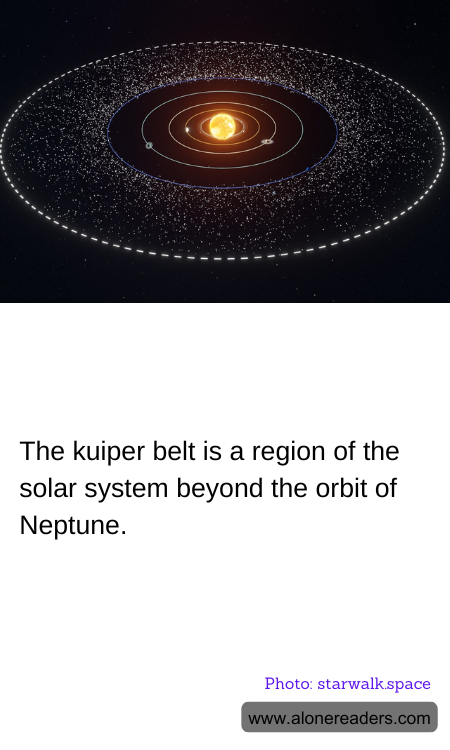
The Kuiper Belt is an expansive region of space located beyond the orbit of Neptune, extending roughly from 30 to 50 astronomical units (AU) away from the Sun. This distant zone is populated by a vast collection of icy bodies and remnants from the solar system’s formation, which occurred over 4.5 billion years ago. Notable for its role in expanding our understanding of the solar system, the Kuiper Belt is often likened to the asteroid belt, although it is about 20 times as wide and 200 times as massive.
The objects within the Kuiper Belt are immensely varied in shape and size. They include small chunks of ice and rock, as well as larger bodies known as dwarf planets. Pluto, perhaps the most famous Kuiper Belt Object (KBO), was reclassified from a planet to a dwarf planet in 2006 due to the discoveries made in this region, which highlighted that Pluto is only one of many substantial bodies in the belt. Other significant dwarf planets in this area include Haumea, Makemake, and Eris, each with its own unique characteristics and moons.
The study of the Kuiper Belt has significant implications for understanding the history and evolution of our celestial neighborhood. KBOs are essentially leftovers from the solar system's early days, providing valuable insights into its composition and the processes that governed its early development. Because these objects have remained relatively unchanged since their formation, they offer a pristine record of the solar system’s primordial materials.
The exploration of the Kuiper Belt has been boosted by missions like NASA’s New Horizons. After its historic encounter with Pluto in 2015, New Horizons continued deeper into the Kuiper Belt and performed a close flyby of Arrokoth (formerly known as 2014 MU69) in 2019. Arrokoth’s highly preserved condition and unique two-lobed shape have furnished more clues about the processes leading to planetary formation.
Scientists hypothesize that the Kuiper Belt might house thousands of more undiscovered bodies, including potentially larger ones. The ongoing study of this remote region not only helps astronomers understand more about the outer reaches of our own solar system but also provides insights that may apply to exoplanetary systems around other stars, potentially altering our understanding of how planets form and evolve across the universe. The mysteries of the Kuiper Belt encourage continuous observation and research, pushing the boundaries of space exploration and our comprehension of the cosmos.
