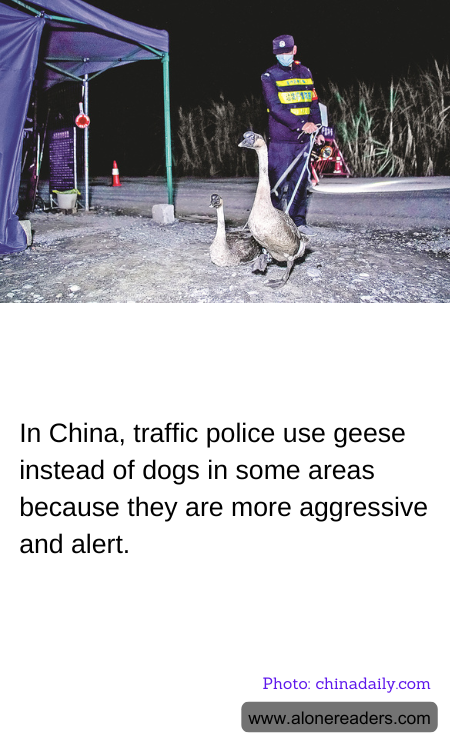
In parts of China, the police force employs a rather unusual yet effective member in their ranks - geese. Known for their aggressive nature and keen alertness, these birds are being utilized in place of the traditional police dog in certain low-crime areas. Geese have a naturally high sensitivity to movements and sounds, which make them excellent sentries. Coupled with their territorial behavior and loud honking when perturbed or when strangers approach, they are remarkably effective at deterring potential trespassers or criminals.
The choice of geese over dogs has several compelling reasons behind it. First and foremost, geese can be just as intimidating as dogs; their aggressive behavior when confronting invaders makes them natural guardians. Moreover, geese have excellent vision, even at night, which is a significant advantage in surveillance.
Their maintenance is also considered to be less demanding compared to that of dogs. Geese are generally more adaptable to various weather conditions and can sustain themselves on a variety of food sources available in their environment. This ease of care makes them particularly suited for more rural or remote areas, where resources might be scarce or when a robust infrastructure for more sophisticated security measures is lacking.
Integrating geese into the security forces is also a cost-effective solution. The training and upkeep costs of a police dog can be quite high, encompassing specialized training courses, food, medical care, and handlers' expenses. Geese, on the other hand, require relatively minimal training focused mainly on their interaction with their handlers and adaptation to certain stimuli relevant to security tasks.
While the use of geese by police might not be applicable universally, their employment in specific contexts in China underscores a creative approach to law enforcement that leverages the natural behaviors of animals. This not only reduces costs but also utilizes local resources, making it a synonymous choice for sustainability and efficiency in community policing.
