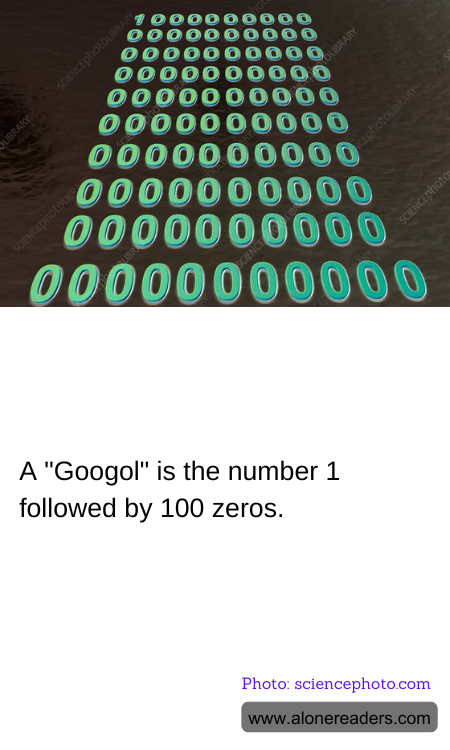
The term "googol," which represents a number equal to 1 followed by 100 zeros, was first coined in 1938 by nine-year-old Milton Sirotta, nephew of American mathematician Edward Kasner. Kasner was discussing large numbers with his young nephew and asked him for a name to describe a number with an unimaginably large value, leading to Sirotta's creation of "googol." Interestingly, the number spawned a further conceptual extension to "googolplex," which Kasner defined as 1 followed by a googol of zeros.
In numerical terms, a googol is written as 10^100, which is exponentially larger than numbers we typically use in daily calculations. In fact, the total number of atoms in the observable universe is estimated to be far less than a googol, illustrating the impracticality of this number for practical numerical applications. Instead, the concept mainly exists in the realm of theoretical mathematics and has become synonymous with representational largeness.
The googol is significant not just in the world of mathematics, but also in popular culture, notably influencing the name of the internet company Google. The founders of Google, Larry Page and Sergey Brin, opted for this variant as a reflection of their mission to organize the vast amount of information available on the internet. The mistake in spelling—a common rendition of "googol" as "google"—became the now globally recognized brand name.
Despite its massive size, the mathematical importance of googol comes into play particularly in discussions about infinity and in comparing sizes of vastly different quantities. In computing and the digital world, where data is growing exponentially, the concept helps in understanding the scale of possibilities, though practical use of such a large number remains limited to theoretical discussions. In essence, the googol symbolizes both the unimaginable and the boundless potential of numbers in mathematical thought.
