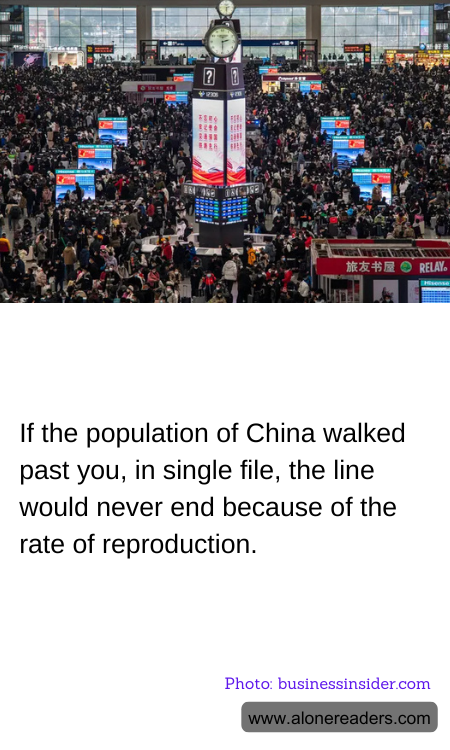
China, with its massive population, has long captured global attention. The concept that if the population of China walked past you in single file, the line would never end due to the rate of reproduction is an intriguing thought experiment that underscores the sheer enormity of the nation's demographics.
To put this idea into perspective, China houses over 1.4 billion people, making it the most populous country in the world, although closely followed by India. The visualization of such an endless procession underscores not just the vast numbers, but also the continuous growth of the population. While China has seen a significant deceleration in its birth rate following decades of strict birth control measures, including the infamous one-child policy, it still experiences a sizeable number of births each year. This natural increase adds continually to the total population, albeit at a slower pace than in past decades.
The phenomena can also be explored from a mathematical standpoint. Given the average walking speed of a human and the rate of birth in China, theoretically, more people would be born in the time it would take for such a line to pass any given point than would pass that point, thus creating an unending line. This scenario, while hypothetical, draws attention to ongoing issues related to population dynamics, such as aging, urbanization, and sustainability.
Moreover, this illustration prompts discussions about resource allocation, economic development, and environmental impact, pivotal areas for a densely populated nation like China. It also parallels challenges faced by other populous nations, providing a stark visual for understanding global population issues and the continual need for comprehensive planning and policy-making in response to demographic changes. Thus, while the idea of an unending line of people might be a hyperbolic visualization, it effectively emphasizes the ongoing, dynamic challenge of population management in large nations.
