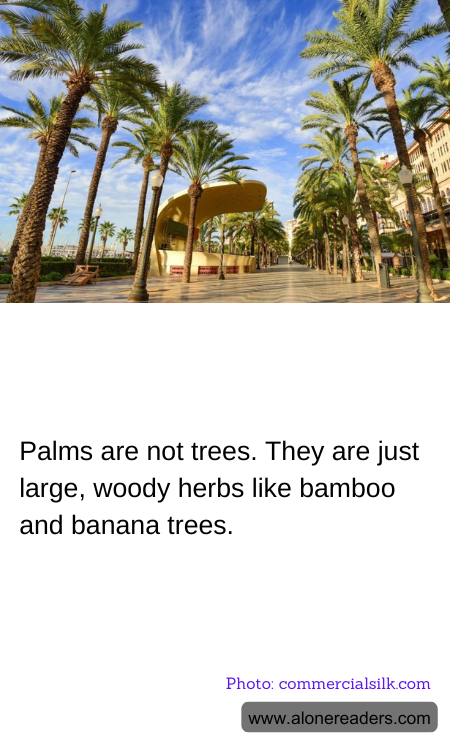
Palms, commonly recognized for their distinctive appearance with large leaves and a usually unbranched trunk, are fascinating in their botanical classification. Contrary to popular belief that categorizes them as trees, palms are indeed more closely aligned with large woody herbs. This categorization places them in a unique position within the plant kingdom, sharing more characteristics with other monocots such as bamboos and banana plants than with true trees.
The primary distinction lies in their growth structure and vascular system. Unlike trees, which have a complex system of branches and grow secondary tissues that allow them to widen and develop thick trunks with rings, palms grow in a more straightforward manner. Their trunks are essentially unbranched stems with thickened, fibrous material that provides structural support but does not include secondary growth or true wood. This growth pattern is similar to that of bamboo and bananas, which also exhibit a 'pseudo-woody' structure made up of tightly packed fibers.
Moreover, the leaves of palms are large and generally feather-shaped or fan-like, and these only grow at the top of their trunks, which is quite different from the branching complexity observed in hardwood or coniferous trees. Additionally, the way palms reproduce aligns with other monocots. They flower and produce seeds differently from many tree species, emphasizing their classification among herbaceous plants albeit their towering heights and robust appearances.
In essence, while palms may superficially resemble what we typically think of as trees, their biological makeup and growth patterns align them more closely with other large, woody herbs. This reclassification broadens our understanding of plant diversity and challenges our conventional perceptions of what a tree is, aligning more with botanical accuracy than common vernacular. Understanding such nuances in plant biology not only fascinates but also highlights the complexity and diversity of the plant kingdom.
