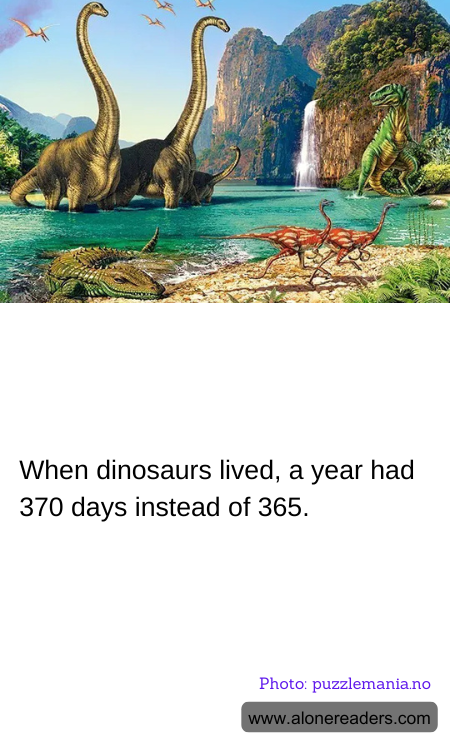
The concept that a year during the time of the dinosaurs had more days than it does now is a fascinating insight into Earth's geological and celestial history. It's true that when dinosaurs roamed the planet, the Earth's rotation was faster than it is today, resulting in more days per year. Approximately 200 million years ago, a year might have had as many as 370 days, compared to the current 365 days. This phenomenon can be attributed to the gradual slowing down of Earth's rotation over millions of years, a process influenced by the gravitational pull primarily from the moon.
This slowing of Earth's rotation is due to tidal forces between Earth and the moon. As the moon's gravity pulls on the Earth, it creates tidal bulges on the planet. As Earth rotates, these bulges attempt to align with the moon, but due to Earth's rotation, they are slightly ahead of the moon's orbit. This misalignment causes the moon to pull back on the bulges, slowing Earth's rotation down, a dynamic known as tidal braking. Consequently, over vast periods, this interaction has led to the increase in the length of a day, from around 23 hours during the Mesozoic era to 24 hours today.
Moreover, this gradual deceleration has implications beyond just the number of days in a year; it affects the Earth's electromagnetic field, climate patterns, and even the mechanics of biological evolution. For example, the longer days could have impacted photosynthesis rates, influencing plant life cycles and subsequently, the diets and behaviors of herbivorous dinosaurs, which in turn would affect the entire ecosystem.
Understanding these changes in Earth's rotational speed helps scientists piece together the complex puzzle of our planet’s deep history and provides crucial insights into Earth’s past environments. This knowledge not only enriches our understanding of geological and biological processes but also aids in making predictions about Earth's future climatic and biological scenarios.
