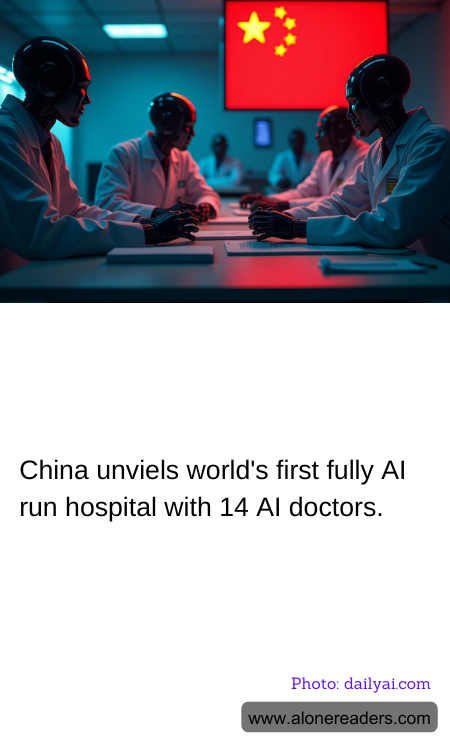
In a groundbreaking development, China has unveiled the world’s first fully AI-run hospital, integrating cutting-edge artificial intelligence technology into every facet of medical care. This futuristic facility is staffed by 14 AI "doctors," each programmed to handle different specialties, including diagnostics, surgery, and patient management, demonstrating a monumental leap in healthcare technology.
These AI doctors are built on sophisticated algorithms and machine learning processes, enabling them to assess symptoms, diagnose diseases, and even recommend and administer treatments with remarkable precision and efficiency. Enhanced by neural networks, the AI doctors can learn from vast amounts of medical data, improving their diagnostic and treatment capabilities over time.
The AI-run hospital, located in a major Chinese city, aims to address various challenges that the healthcare sector faces today, such as physician shortages, reducing human error, and managing the high volume of patients efficiently. This innovative approach not only maximizes resource allocation but also ensures that high-quality healthcare is more accessible and available round-the-clock.
The facility is equipped with state-of-the-art medical technology, including robotic surgical tools, which the AI doctors use to perform complex procedures with a level of accuracy that rivals, and sometimes surpasses, that of human surgeons. The integration of AI extends to patient management and care, with systems designed to monitor patient conditions continuously, adjust treatments as needed, and even handle routine tasks and interactions.
Critically, all systems operate under stringent privacy and security protocols to protect patient data, a fundamental concern that has been addressed from the ground up. The Chinese government and the hospital's administration have emphasized their commitment to ethical standards, ensuring that all AI applications in the hospital are transparent, with safeguards in place to prevent any form of bias or error that could negatively impact patient care.
This pioneering initiative not only showcases the potential for AI to transform healthcare but also sets a new global benchmark for innovation in medical services. As AI technology continues to evolve, it is expected that similar models could be adopted worldwide, fundamentally altering the way healthcare is delivered. The success of this AI-run hospital could pave the way for a new era in the medical field, where technology and human expertise combine to enhance patient outcomes more effectively than ever before.
