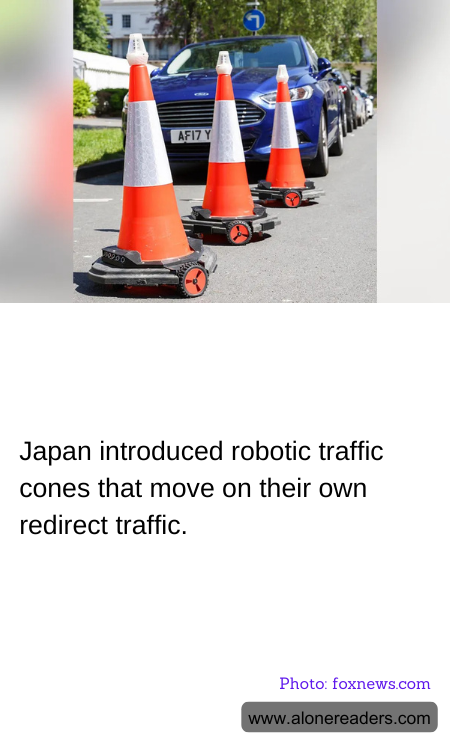
In a bid to enhance road safety and efficiency, Japan has introduced an innovative solution in the form of robotic traffic cones, which have the ability to move autonomously to redirect traffic. This cutting-edge technology aims to reduce the need for human involvement in potentially hazardous traffic situations, particularly during road construction or in the event of an accident.
These robotic cones are designed to be deployed from a centralized control system, which can manipulate their positions based on real-time traffic conditions. Each cone is equipped with sensors and communication modules that enable it to navigate to specific locations. This automation not only minimizes the risk for traffic controllers and construction workers, who traditionally had to manually place and move these cones, but also enhances the precision of traffic management.
The technology behind these robotic cones leverages advancements in artificial intelligence and robotics, allowing for smooth coordination among the cones. They can automatically detect the safest and most efficient configurations to manage traffic flow and can adjust in real-time to changes in traffic patterns. For instance, during peak hours or in emergencies, the cones can be programmed to create diversions or extra lanes, directing vehicles safely around obstacles or hazardous spots.
Moreover, the ability of these cones to swiftly reposition themselves is particularly advantageous in dynamic traffic environments. It reduces the time taken to set up or modify traffic patterns, which contributes to reduced traffic congestion and lower stress for drivers. Additionally, night-time visibility of roadworks can be improved with these illuminated robotic cones, enhancing safety during hours when human workers are most vulnerable.
The introduction of robotic traffic cones is part of Japan's broader initiative to integrate more automated systems into public infrastructure, thus paving the way for future advancements in autonomous transportation networks. As these technologies continue to evolve, the deployment of such autonomous devices could become standard practice, not only in Japan but globally, heralding a new era in traffic management and road safety.
