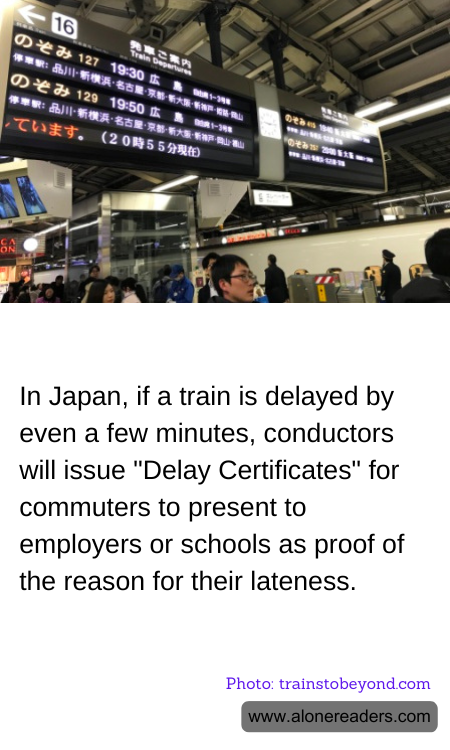
In Japan, the punctuality of public transportation, especially trains, is taken very seriously. Trains are so timely that a delay of even a few minutes is considered an anomaly and can disrupt the day's schedule for thousands of commuters. To address this, Japanese train companies issue "Delay Certificates" to passengers whenever a train is late. These certificates serve as an official explanation for a commuter’s tardiness to employers or schools.
The practice underscores the high level of accountability and service that characterizes Japanese public transportation. These delay certificates, or "chien shoumeisho", are given out by train conductors or station staff, ensuring that passengers have valid proof if their train is delayed. This system is particularly important in a culture that values punctuality and efficiency, where being late, even due to unforeseen circumstances, can be seen as inconsiderate or unprofessional.
Moreover, this focus on stringent timekeeping and customer service is reflective of the broader Japanese dedication to omotenashi, or the spirit of selfless hospitality. It's not just about preventing any inconvenience to employers or schools, but also about the train operators owning their service levels so comprehensively that they formally acknowledge any slips in standards, no matter how slight.
Interestingly, the issuance of delay certificates also highlights the technological and operational excellence of the Japanese rail system. Delays are rare, and when they occur, are often due to uncontrollable factors such as natural disasters. In many cases, the delay needs to be longer than five minutes for certificates to be issued, although this time frame can vary depending on the train company or specific circumstances.
This unique approach not only helps maintain order and responsibility but also builds trust and reliability in the transportation system, setting a global benchmark in customer service and operational management. In essence, through the provision of delay certificates, Japan exemplifies how respect for individuals' time and commitments can be seamlessly integrated into public service frameworks.
