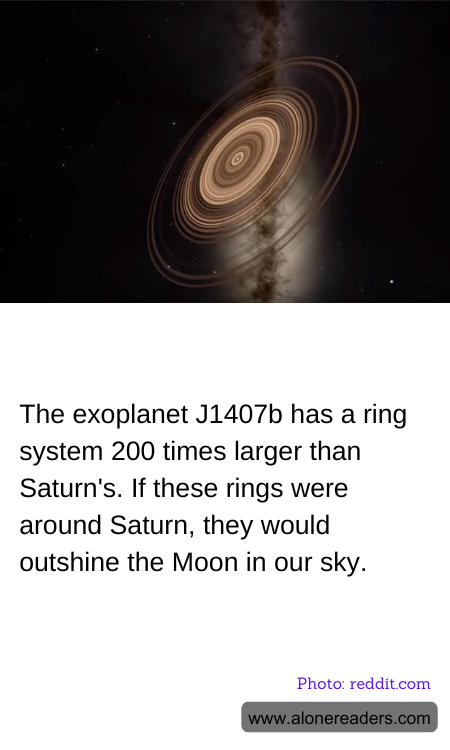
The exoplanet J1407b, located hundreds of light years away from Earth, presents a celestial marvel that has captivated astronomers and sparked imaginations. Discovered in an orbit around the star 1SWASP J140747.93-394542.6, J1407b is an extraordinary gas giant with a feature that sets it apart: a colossal ring system that dwarfs the one surrounding Saturn, famously known for its beautiful rings. This ring system is not just slightly larger—it is approximately 200 times the size of Saturn's rings.
The sheer magnitude of J1407b's rings is hard to comprehend. Spanning nearly 90 million kilometers, the rings greatly extend the exoplanet's observable size. To put this into perspective, if Saturn were to be graced with J1407b's ring system instead of its own, the rings would stretch almost to the orbit of Earth's Moon and be a prominent feature in our night sky, outshining the Moon. This comparison highlights not just the size of J1407b's rings but emphasizes the incredible scale of planetary systems that exist beyond our own.
These massive rings also contribute to fascinating celestial phenomena. For instance, they lead to complex and dramatic eclipses of the host star, J1407, casting shadows that provide fertile ground for scientific study. Observations of such eclipses have allowed astronomers to infer the presence, size, and structure of the rings, even though the exoplanet itself remains too distant to be observed directly with current technology. Moreover, gaps detected within the rings suggest the possible presence of exomoons, which might be forming in the same manner as the moons around Saturn, embedded within and carved out by the rings themselves.
The discovery and study of J1407b and its rings challenge existing models of ring formation and longevity. The formation of such an expansive ring system indicates dynamic evolutionary processes and raises questions about the conditions under which they formed and how they have persisted without collapsing or dispersing. Further, studying J1407b offers a glimpse into the early years of our own Solar System, when Saturn and Jupiter might have sported similarly expansive ring systems during their formation.
Indeed, exoplanets like J1407b push the boundaries of our understanding of planetary systems and prove that our universe holds many surprises yet to be discovered. As technological capabilities in telescope design and space exploration continue to advance, the mysteries of exoplanets like J1407b will gradually unfold, providing deeper insights into the workings of our cosmos.
