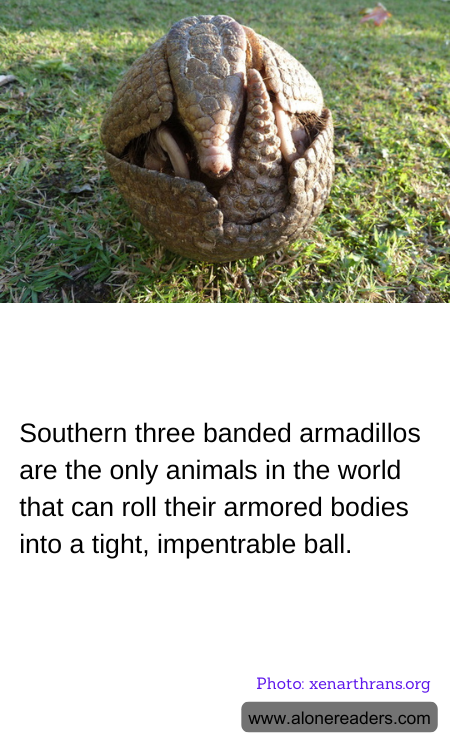
The Southern three-banded armadillo, native to parts of South America, including Brazil, Argentina, and Paraguay, possesses a uniquely fascinating defense mechanism among mammals. Unlike other species, it can curl itself into a complete ball when threatened, its armored shell fitting perfectly to shield its vulnerable underparts from potential predators. This ability is particularly distinctive as it makes the armadillo nearly impervious to predation, with no visible weak spots when it is fully curled up.
The Southern three-banded armadillo's shell consists of hard bony plates covered in keratin, the same material found in human nails. This armor is segmented into three flexible bands, giving the creature the mobility to rapidly roll up into a tight ball. The edges of its shell neatly tuck in, effectively sealing its body inside, a feature that is the primary reason it can attain such an effective defensive posture. The mechanism is so efficient that even the most persistent predators usually fail to find a way through the tough, overlapping plates.
Biologically, this ability not only protects the armadillo from predators but also minimizes water loss in the arid environments it often inhabits, making it a critical survival adaptation. The armadillo's diet primarily consists of insects, which it forages using its sharp claws to dig into the ground. When not feeding or when threatened, it spends much of its time tucked away safely in burrows or tightly wound up in its armored shell.
Reproduction and development in these armadillos also highlight their distinctiveness. After a gestation period of about four months, females typically give birth to a single offspring. This young armadillo is born with a soft shell that hardens over time, reaching full protective capability several weeks after birth. Conservation efforts are vital as the Southern three-banded armadillo faces threats from habitat loss and hunting. Though not currently classified as endangered, their populations are impacted by human activities, particularly habitat conversion for agriculture and urban development.
Intriguingly, the unique biological and physical traits of the Southern three-banded armadillo have made it a subject of interest not only for naturalists and wildlife enthusiasts but also for engineers and designers in biomimicry. The principles underlying its defensive armor are studied for applications in materials science and military technology, showcasing a remarkable example of how nature's design can inspire innovative human solutions. Thus, while it might be small and unassuming, the Southern three-banded armadillo stands out as a remarkable specimen of evolutionary ingenuity and resilience.
