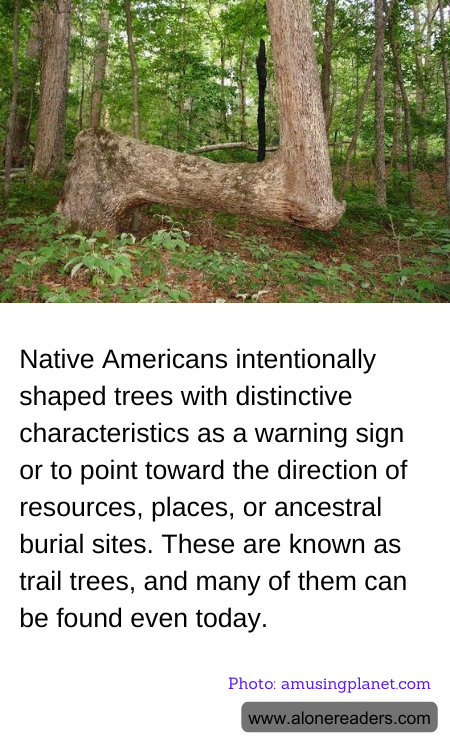
Trail trees are a fascinating aspect of Native American heritage scattered across the North American landscape. These trees were skillfully manipulated and trained by indigenous people to grow into unusual shapes and forms, serving as navigational aids, markers of significant resources, or spiritual sites. The art of shaping these trees typically involved bending young saplings and securing them in position using weights or ties, with the intention that the tree would maintain this form as it matured and grew. Over decades and even centuries, these markers have stood as silent witnesses to the histories and cultures of their creators.
The cultural significance and purposes of trail trees vary among different tribes and regions. For many, they marked paths leading to important destinations such as water sources, river crossings, shelter areas, or even ceremonial and burial sites. Others pointed the way along complex trading routes, acting not just as mere directional signs but also as markers of safe passage, communicating information about territorial boundaries and peace treaties between different tribal groups.
Finding and recognizing these trees in the modern era requires a keen eye and an understanding of their subtle features. Typically, the trees exhibit a sharp bend at their base, followed by an elongated trunk growing horizontally before turning upwards again. Some trees might have additional bends or twists signaling specific directions or important locations.
Today, many trail trees are at risk due to natural aging, urban development, and environmental changes. Conservationists, along with various Native American groups, have undertaken efforts to document and preserve these living monuments. Recognizing and respecting these trees is not only vital for historical preservation but is also a matter of acknowledging and honoring the rich cultural practices of the indigenous peoples who shaped the landscape of North America in such a unique and enduring way.
Identifying, mapping, and maintaining these trail trees offer invaluable insights into the past, telling stories of survival, ingenuity, and the deep bond between the Native American cultures and their environments. Preserving these trees continues to be a poignant challenge and a call to acknowledge the sophisticated knowledge and practices of the indigenous people who first walked these lands.
