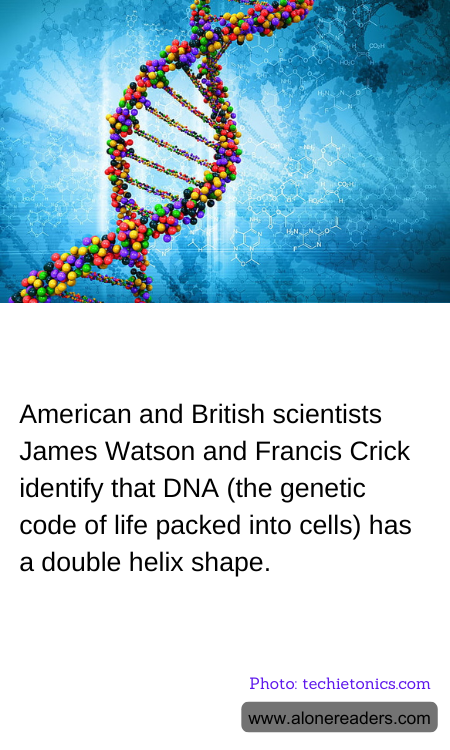
In 1953, one of the most significant scientific discoveries was made by American geneticist James Watson and British physicist Francis Crick, who identified that DNA, the molecule that carries the genetic instructions for the development, functioning, growth, and reproduction of all known organisms and many viruses, has a double helix structure. This discovery was groundbreaking because it provided the first clear molecular structure of DNA, which has profound implications on understanding how genetic information is stored, transmitted, and replicated.
The double helix model suggested that DNA consists of two strands that coil around each other, forming a ladder-like structure that is twisted into a spiral. The sides of the ladder are formed by alternating sugar and phosphate groups, and the rungs consist of nucleotide bases paired together using hydrogen bonds: adenine with thymine, and guanine with cytosine. This specific pairing, and the way the two strands are anti-parallel with one running 5' to 3' and the other 3' to 5', facilitates the replication of the genetic material in a semi-conservative manner, where each strand serves as a template for a new one.
Watson and Crick's model was based on the experimental data of other scientists, most notably Rosalind Franklin and Maurice Wilkins, who had used X-ray diffraction techniques to study the structure of DNA. Franklin's famous "Photo 51" was critical as it provided the key evidence of the helical structure of DNA, although her contributions were initially less recognized.
The elucidation of DNA's structure answered many fundamental questions about heredity and paved the way for modern genetic research. This includes the development of biotechnology, genetic engineering, and forensic science techniques, among others. The discovery also led to Watson, Crick, and Wilkins being awarded the Nobel Prize in Physiology or Medicine in 1962.
In sum, the identification of the double helix structure was not just a milestone in genetics and biochemistry, it revolutionized the biological sciences, transforming our understanding of life itself and opening new avenues in medical and scientific research that continue to benefit human health and knowledge even today.
