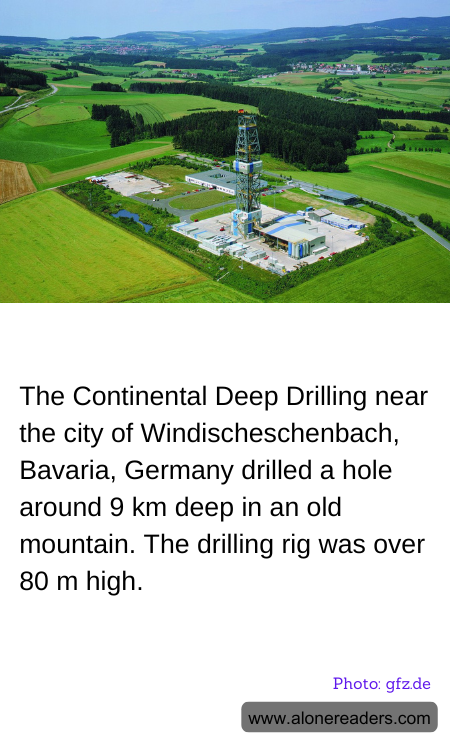
The Continental Deep Drilling Project (Kontinentales Tiefbohrprogramm der Bundesrepublik Deutschland, or KTB) near Windischeschenbach in Bavaria, Germany, aimed to provide a wealth of scientific data on the Earth's crust. Initiated in the 1980s, the project saw the construction of a gigantic drilling rig, towering about 80 meters high, which was instrumental in boring a hole about 9 kilometers deep into an ancient mountain range.
This ambitious endeavor was not merely an exercise in engineering prowess but a significant research venture aimed at enhancing our understanding of geological formations and processes. Drilling at such depths allowed scientists to study the composition, heat flow, seismicity, and rock mechanics of the Earth's crust in unprecedented detail. The KTB site was strategically chosen for its location in the Variscan belt of Europe, which is rich in geological history and complexities, making it an ideal spot for achieving the project's scientific goals.
The findings from the KTB project have had broad implications for both geosciences and applied technologies such as geothermal energy development. By reaching subterranean depths that few other drills have ever achieved, the project helped clarify the nature of the continental crust and has contributed valuable insights into the thermal and mechanical behaviors of rocks at extreme depths.
Moreover, the KTB drilling project was noteworthy for its minimal environmental impact, demonstrating that deep drilling could be conducted responsibly and sustainably. The project set new standards in drilling technology, including the implementation of innovative techniques for core extraction and onsite analysis, which are now widely used in other deep drilling projects around the world.
In addition to its scientific contributions, the Continental Deep Drilling project has also had a social impact by boosting local economies and fostering international collaborations among scientists. The data and samples collected have provided important resources for ongoing research and education, offering a deeper understanding of our planet's underpinnings.
