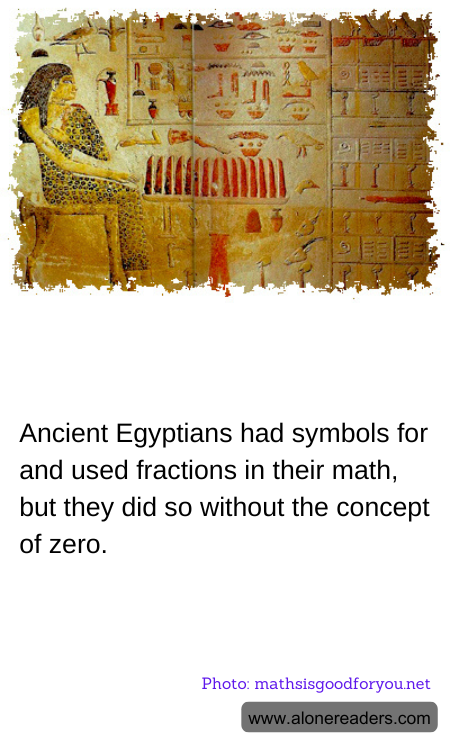
In the intriguing world of Ancient Egyptian mathematics, fractions hold a special place. The Egyptians developed a sophisticated understanding of fractions, yet their numerical system intriguingly lacked the concept of zero, which is fundamental in modern mathematics. Instead, Egyptian mathematics revolved around the concept of parts, primarily using fractions to express quantities less than one.
The Egyptian use of fractions was largely based on the inverse of integers (except for the number one) and fractions were typically written as sums of different unit fractions, a form known as Egyptian Fractions. Each fraction in this system was represented as the sum of distinct fractions where each numerator is 1, such as 1/2, 1/3, 1/4, and so on, except for the fraction 2/3 which was used frequently on its own. This approach differs markedly from the modern use of fractions, which involve numerators greater than one.
For more complex arithmetic, including calculations involving fractions, Egyptians utilized a method that could be seen in the Rhind Mathematical Papyrus, dating back to around 1550 BCE. This document includes techniques for adding, subtracting, multiplying, and even dividing fractions using series of unit fractions. The papyrus showcases problems and their solutions providing a fascinating glimpse into the advanced mathematical concepts of the time.
The lack of zero in Egyptian mathematics is particularly noteworthy. Unlike some later cultures, such as the Ancient Indians and Mayans, who developed a concept of zero as a placeholder or an actual number, Egyptians managed complex calculations without using zero. Their system did not require zero because their arithmetic dealt exclusively with tangible quantities that could be represented without it, especially in architecture and astronomy, where specific measurements were needed and zero would have no practical application.
The reliance on unit fractions and the absence of zero highlight the practical nature of Egyptian mathematics, which was primarily focused on solving daily problems and was closely linked with their needs in agriculture, construction, and astronomy. This approach to mathematics demonstrates the ability of ancient civilizations to develop complex mathematical systems tailored to their environmental and cultural contexts, contributing significantly to the field's evolution well before the widespread acceptance of the zero concept in the mathematical practices of other cultures. The ingenuity of Egyptian mathematics not only served their practical needs but also laid a groundwork that influenced later mathematical development in Greece and beyond.
