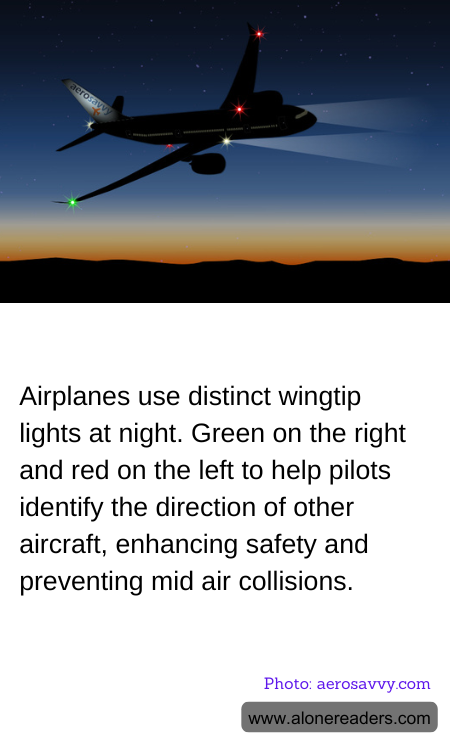
Airplanes are equipped with specific navigation lights on their wingtips, which play a critical role in night-time flight safety. These lights are designed to indicate the direction an aircraft is facing from a distance. The standard arrangement includes a green light on the right wingtip and a red light on the left wingtip. This color coding is consistent with maritime navigation rules, where similar lights are used to indicate the port (left side, red light) and starboard (right side, green light) sides of boats and ships.
The purpose of these distinct lights is to help pilots determine the relative position and movement of other aircraft during periods of low visibility, such as at night or in poor weather conditions. By observing the colors of the lights, a pilot can instantly recognize which direction another aircraft is heading. For example, if a pilot sees green and red lights side by side with the green light on the left, it means that the aircraft is facing towards them, potentially indicating a head-on approach. Conversely, seeing red on the left and green on the right suggests that the other aircraft is moving in the same direction.
This simple yet effective system enhances flight safety by preventing mid-air collisions. It also assists in navigation and maneuvering on the tarmac, serving as a quick visual cue for other pilots and ground traffic controllers. Overall, these wingtip lights are a fundamental aspect of aviation safety protocols, ensuring that even under the cover of darkness, aircraft can share the skies safely.
