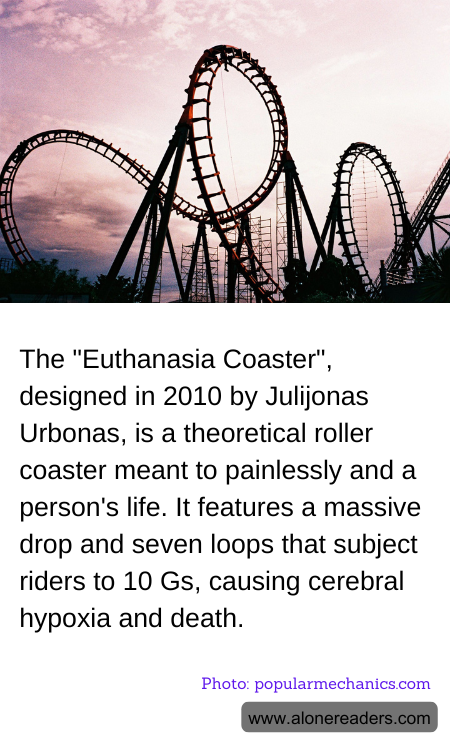
The Euthanasia Coaster is a concept that has stirred both intrigue and controversy since its introduction by Julijonas Urbonas in 2010. Designed as a thought experiment more than a feasible construction project, it tackles the complex themes of life, death, and technology’s role in these final moments. The design of the coaster includes a series of intense engineering features intended to end human life "with elegance and euphoria", as Urbonas, a PhD candidate at the Royal College of Art in London, has described.
The most striking part of the coaster’s design is its initial drop, which stands at a staggering height of 500 meters, allowing it to reach fatal speeds. This is followed by seven consecutive loops that are designed to maintain a force of 10 Gs on the rider's body for each loop, ultimately resulting in cerebral hypoxia, where the brain is deprived of adequate oxygen supply to sustain bodily functions, leading to death. The physiological basis behind this is that such extreme sustained g-forces would inevitably cause blood to rush away from the brain towards the lower extremities, thereby leading to loss of consciousness followed by death.
Urbonas crafted the Euthanasia Coaster during a period when discussions around euthanasia and assisted suicide were (and continue to be) highly charged, ethically and legally. His work is intended as a sort of protest art, provoking discussions on the rights of the dying, and the potential uses and misuses of technology in managing or ending life. While it's highly unlikely that the Euthanasia Coaster will ever be constructed due to the numerous ethical, legal, and logistical issues it raises, its conceptual creation has been successful in pushing the boundaries on conversations about how society views death and dying, interfacing these topics with the fields of art, design, and technology.
The Euthanasia Coaster raises multiple ethical questions, particularly concerning the voluntary aspect of such a death — whether a momentary decision to end one’s life could truly be considered rational or consensual under the circumstances. It also examines the societal roles and responsibilities in preserving life or facilitating death. Is the sanctity of life something to be maintained at all costs, or do individuals have the sovereign right to end their pain and suffering as they see fit, even if that means employing such a drastic method?
While the Euthanasia Coaster remains a theoretical and artistic expression, it serves as a stark reminder of the often uncomfortable interface between technology and the most personal human conditions, prompting deep reflection on the future of our handling of life and death.
