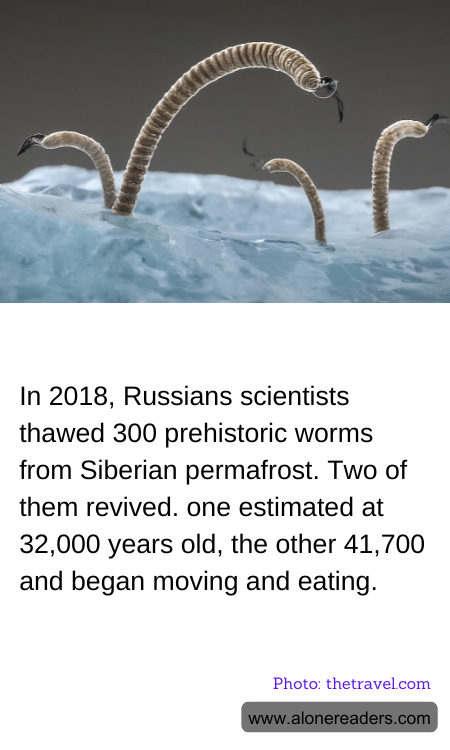
In a remarkable scientific feat, Russian researchers successfully revived microscopic roundworms that had been encased in Siberian permafrost for tens of thousands of years. The worms, known as nematodes or roundworms, were extracted from core samples taken from the permafrost, one estimated to be around 32,000 years old and the other approximately 41,700 years old. This groundbreaking study not only highlights the incredible resilience and survival strategies of certain organisms but also opens up new avenues in the field of cryobiology.
Upon being thawed carefully in a laboratory setting, two of the ancient nematodes began to show signs of life. They started moving and eating, thereby becoming the oldest living animals ever recorded on Earth. This discovery is significant because it validates the concept of cryobiosis, where organisms can enter a reversible state of suspended animation when exposed to extremely low temperatures. Such a phenomenon is not just of academic interest but could have practical applications, such as in the preservation of species and cells.
The nematodes’ revival after such a long period suggests that complex multicellular organisms can withstand extended periods of freezing under natural conditions, a subject that could have implications for astrobiology and the search for life on other planets. If life can endure the harsh conditions of Earth's permafrost for tens of thousands of years, it might also persist in the similarly extreme environments found on Mars or Jupiter's moon Europa.
This also sparks a broader debate about the melting of permafrost due to climate change. There's concern about what other organisms, potentially pathogenic to humans or livestock, could be released as permanently frozen grounds continue to thaw. This poses unknown risks that scientists are just beginning to explore.
Overall, the revival of these prehistoric organisms not only sets a historical benchmark in biological research and our understanding of life's resilience but also serves as a reminder of the unforeseen consequences of climate change. As permafrost continues to melt, releasing gases and potentially harmful biological agents, understanding these effects is essential for developing strategies to mitigate impacts on ecosystems and human health.
