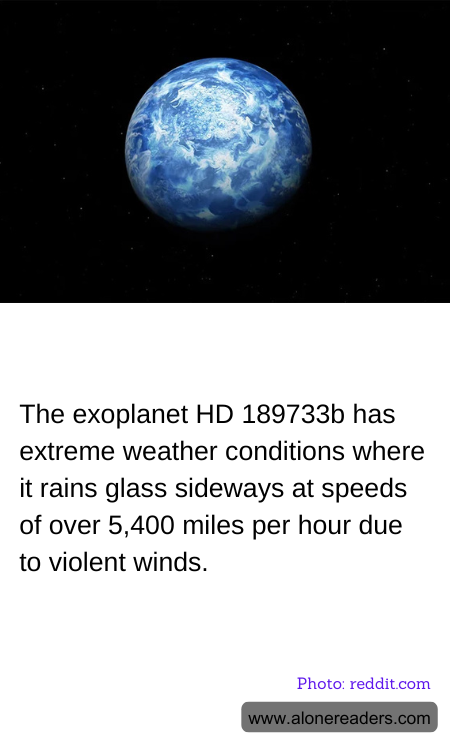
HD 189733b, located about 63 light-years away in the constellation Vulpecula, is an exoplanet known for its extreme and exotic weather conditions. This planet, which is slightly larger than Jupiter, orbits its host star every 2.2 days at a close distance, making it one of the so-called "hot Jupiters." These are gas giant planets that orbit very close to their stars, experiencing intense gravitational and radiation forces.
What makes HD 189733b particularly fascinating is its atmosphere, which exhibits behaviors unlike anything seen on Earth. The planet's high temperatures, which can soar above 1,000 degrees Celsius, and its furious wind speeds, reaching over 5,400 miles per hour, create a maelstrom of weather activity that is difficult to comprehend. These winds are more than seven times the speed of sound, and such extreme conditions contribute to the planet's unique meteorological phenomena: rains of molten glass that streak horizontally across the skies.
The atmosphere of HD 189733b contains high concentrations of silicate particles. The extreme heat and turbulent winds vaporize these silicates, causing them to condense into clouds. The ferocious winds then whip these glass particles across the planet's atmosphere, causing sideways glass rain. Unlike anything experienced in Earth's weather system, this phenomenon adds a layer of complexity to our understanding of atmospheric science across the universe.
The study of such hostile environments not only helps astronomers determine the weather patterns on other worlds but also aids in the broader understanding of planetary formation and behavior. Detecting and studying these unique weather patterns also provide critical insights into the dynamics of planetary atmospheres under extreme conditions, potentially illuminating how similar processes might work under less extreme conditions on other planets, including Earth.
Through continued observation, using advanced telescopes and space observatories, researchers hope to unlock more secrets held by HD 189733b and other similar exoplanets. This pursuit not only quenches human curiosity about the universe but also enhances our understanding of the potential habitability of exoplanets and the extreme conditions under which life might somehow emerge or sustain itself.
