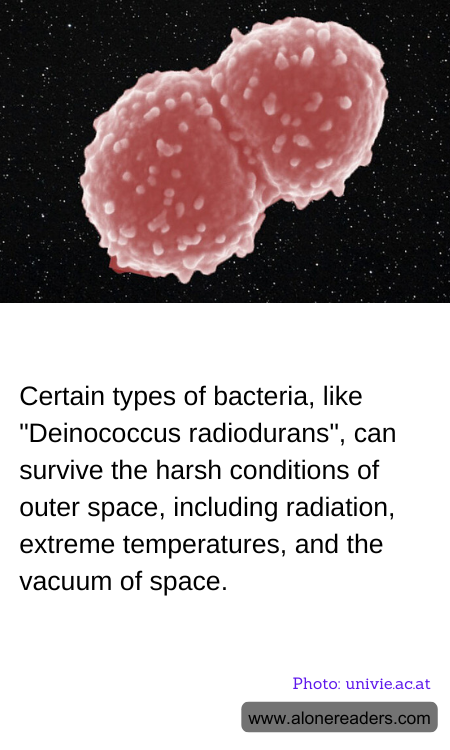
Among the resilient forms of life on Earth, certain bacteria stand out due to their ability to endure extreme environments that are typically deadly for most organisms. One such bacterium is Deinococcus radiodurans, famously known for its impressive resistance to radiation. This resistance not only spans commonly encountered radiation levels on Earth but also extends to the more severe conditions found in outer space. Deinococcus radiodurans can withstand hundreds of times the radiation dose that would be lethal to humans, earning it the nickname “Conan the Bacterium.”
The ability of Deinococcus radiodurans to survive in outer space was tested in experiments where samples of this bacterium were exposed to the harsh conditions of space for an extended period. The vacuum of space, extreme fluctuations in temperature, and high radiation levels did not significantly impair the survivability of this bacterium. Its resilience is attributed to its efficient DNA repair system. After radiation breaks its DNA, Deinococcus radiodurans can piece it back together with remarkable accuracy, a capability unparalleled in other organisms.
Besides its implications for biology, the study of such organisms has significant ramifications for space travel and astrobiology. Understanding the mechanisms underlying the survival strategies of extremophiles like Deinococcus radiodurans can help in developing life support systems for long-duration space missions and in designing bioregenerative life support systems. Additionally, these insights deepen our comprehension of what life forms might exist beyond Earth and how terrestrial life might adapt or be protected in extraterrestrial environments.
Moreover, such extremophiles propose potential applications in biotechnology and medicine, such as in the development of radiation-resistant materials or in the remediation of nuclear waste. The ability to harness the DNA repair mechanisms or other cellular defenses of Deinococcus radiodurans could lead to innovations in fields where radiation is a customary part of the workflow or an inherent risk.
In conclusion, the study of Deinococcus radiodurans and similar extremophiles is a burgeoning area of research with wide-ranging implications. These microorganisms not only challenge our understanding of the limits of life on Earth but also offer promising prospects for enhancing human endeavors in space exploration and other high-stakes environments. Through such research, we continue to push the boundaries of science and explore the resilience of life in its most extreme forms.
