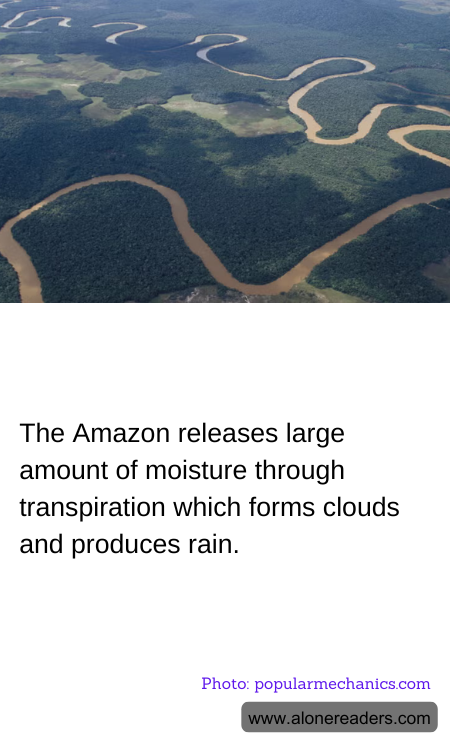
The Amazon Rainforest, often referred to as the "lungs of the Earth," plays a crucial role in regulating the world's oxygen and carbon cycles. However, its influence extends beyond these critical functions. One of the most fascinating aspects of this ecological powerhouse is its ability to control the weather patterns, not just locally but also globally. This phenomenon is largely driven by the process of transpiration, where plants release water vapor from their leaves into the atmosphere.
Transpiration in the Amazon is a massive hydrological event due to the sheer size of the forest and the abundance of plant life. As sunlight penetrates the dense forest canopy, it heats the forest floor and causes water from the soil and vegetation to evaporate. Additionally, the leaves of trees and plants absorb water through their roots and then expel it through their stomata (tiny openings on the underside of the leaf) as water vapor. This massive release of moisture by the extensive flora contributes significantly to the humidity of the Amazon atmosphere.
The water vapor from transpiration doesn't just linger in the air; it has a more dynamic role in the ecosystem. As the moist, warm air rises, it cools and condenses to form clouds. This process is pivotal in generating the thick, dense cloud cover that is characteristic of the region. These clouds are responsible for the substantial rainfall that the Amazon experiences, a phenomenon that is crucial for maintaining its diverse ecosystem. This localized precipitation returns water to the forest, thus sustaining the cycle of growth and transpiration.
Moreover, the Amazon's ability to generate rain from its own transpired moisture influences weather patterns on a larger scale. This is especially evident in its contribution to the global water cycle, where the Amazon acts as a significant "water pump," channeling moisture across continents and oceans. Through atmospheric circulation patterns, the moisture contributes to rainfall in other parts of South America and even potentially affects distant regions like North America.
The sustainability of this vast rain-making machine, however, hangs in the balance due to deforestation and climate change. Clearing sections of the forest for agriculture or logging disrupts the transpiration process, reducing the forest's ability to produce moisture and, consequently, rain. This reduction not only threatens the local biodiversity and indigenous communities relying on the forest for their livelihoods but also has the potential to alter climatic conditions on a global scale.
In conclusion, the Amazon is not just a forest but a critical climatic engine powered by the natural process of transpiration. Its capacity to influence weather systems highlights the interconnectedness of ecological processes and underscores the broader impacts of human activity on the environment. Protecting the Amazon is not merely about conservation efforts within its boundaries but is fundamental to maintaining climatic stability across the planet.
