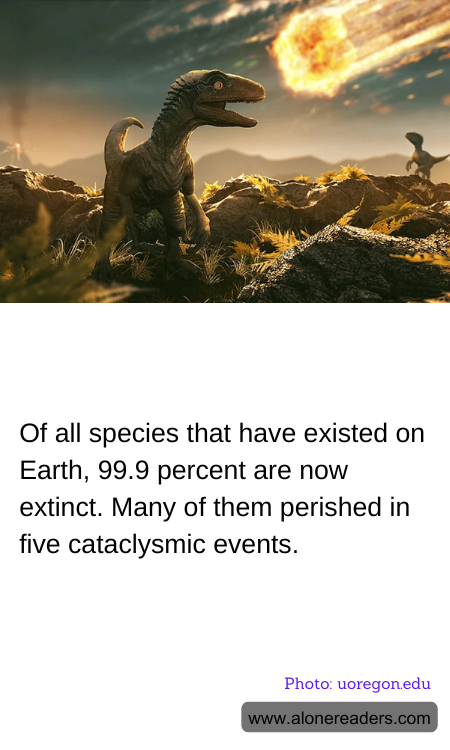
Throughout Earth's history, an astounding 99.9 percent of all species that once roamed the planet are now extinct. This staggering loss of biodiversity is largely attributed to five major mass extinction events, each caused by catastrophic environmental changes that severely disrupted ecosystems globally.
The first of these events, the Ordovician-Silurian extinction, occurred approximately 443 million years ago. This extinction primarily affected marine life, including graptolites and trilobites, largely due to a short, severe ice age that lowered sea levels, possibly triggered by the uplift of the Appalachian Mountains, which absorbed atmospheric carbon dioxide and reduced greenhouse effects.
Approximately 360 million years ago, during the late Devonian period, another major extinction event unfolded. This event is particularly noted for the sharp declines in tropical marine environments and affected prominent groups such as the reef-building corals and stromatoporoids. The causes are speculated to range from meteor impacts to plant evolution, which might have led to the depletion of oxygen in the oceans.
The most devastating extinction occurred at the end of the Permian period, about 252 million years ago, wiping out nearly 96 percent of marine species and 70 percent of terrestrial vertebrate species. This event is sometimes attributed to massive volcanic eruptions in Siberia, which triggered global warming through the emission of large volumes of greenhouse gases. Subsequent ocean anoxia and acidification coupled with drastic fluctuations in climate compounded this catastrophic event.
The Triassic-Jurassic extinction event around 201 million years ago is another critical juncture in Earth’s biological history. This event led to the obliteration of competing reptiles and allowed dinosaurs to ascend to dominance. The cause of this extinction is suggested to be massive volcanic lava flows in the area of present-day Atlantic Ocean seaboard, which released CO2 and increased Earth's temperatures.
The fifth and most famous mass extinction is the Cretaceous-Paleogene extinction event, which occurred 66 million years ago. This event is widely known for the termination of the dinosaurs, and unlike the mostly gradual extinctions of previous events, was caused by a relatively abrupt cataclysm - a giant asteroid impact in present-day Mexico, along with subsequent volcanic activity. The resulting environmental changes included wildfires, acid rains, and a "nuclear winter" effect that drastically cooled the planet.
These five cataclysmic events reshaped life on Earth, each time eliminating dominant species and paving the way for new forms of life to evolve and flourish. These extinctions underscore the vulnerability and resilience of Earth’s biosphere under dramatic environmental stresses.
