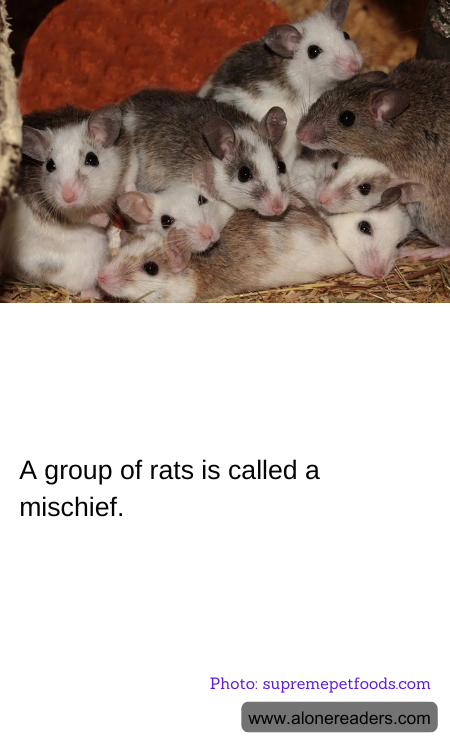
The term "mischief" aptly describes a group of rats, reflecting their playful and sometimes naughty nature. Rats are highly social creatures that thrive in a communal environment, often seen engaging in collaborative foraging, nesting, and grooming behaviors. Their group dynamics are complex and fascinating, marked by hierarchies and social interactions that enhance their survival.
Rats have often been misunderstood and maligned throughout history, frequently associated with disease and filth. However, these intelligent and adaptable animals have a lot to offer in terms of understanding social structures and behavior. In a group, or mischief, rats communicate with each other through high-pitched sounds that are inaudible to human ears, and through pheromones. These communications facilitate the smooth running of their community, helping them avoid predators, find food, and care for their young.
Interestingly, the communal life of rats also showcases their empathetic nature. Studies have shown that rats are capable of empathy, often going out of their way to help a distressed comrade. In a controlled experiment, rats have been observed freeing fellow rats from a restrictive cage, even when a tempting pile of chocolate chips was made available as a distraction.
Observing a mischief of rats can thus provide surprising insights into the complexity of their emotional interactions, such as playing together, which helps strengthen social bonds and even develop problem-solving skills. Some researchers believe that the negative connotations associated with a group of rats have overshadowed their potential role in scientific fields, ranging from studies on human psychology to societal structures.
Therefore, despite their often negative reputation, groups of rats, or mischiefs, are proving to be valuable subjects in scientific research fields that explore complex social behaviors and neurological conditions. The communal and intricate lives of these animals offer a unique perspective on the adaptability and social complexity of mammals, providing broader implications for understanding social sciences and biological research.
