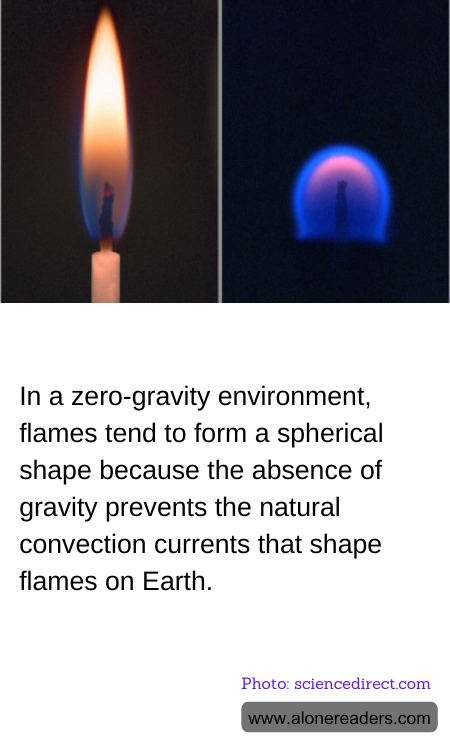
In the fascinating absence of Earth's gravitational pull, the behavior of fire changes dramatically, illustrating some intriguing physics. Normally, flames on Earth take on an elongated, teardrop shape because hot air rises due to the force of gravity inducing convection currents; cooler, denser air flows in from below to replace it, feeding oxygen to the fire and perpetuating the cycle. This results in flames that stretch upward. However, in a zero-gravity environment, such as that experienced in space, this dynamic is disrupted.
Without gravity, the hot air does not rise, and the cool air doesn't sink. Instead, the flow of air around a flame occurs due to molecular diffusion, which is significantly slower than the buoyant flow driven by gravity on Earth. Consequently, in zero gravity, a flame adopts a shape that is quite different from what we see on Earth. It forms into a sphere surrounding the fuel source. This spherical shape results from the fact that in the absence of gravity, the heat and combustion products cannot rise; they spread out evenly in all directions, with the oxygen diffusing inward toward the combustion zone.
Moreover, the spherical flames in zero gravity tend to burn more slowly and with less temperature than their terrestrial counterparts. This happens because the lack of gravity-driven convection reduces the supply of fresh oxygen to the flame, which is essential for combustion. In this environment, the soot and other combustion byproducts also do not get whisked away as efficiently, which can lead to inefficient burning.
Understanding how fire behaves in space is crucial for the safety and design of spacecraft and space stations, not only in terms of dealing with onboard fires but also in designing systems that utilize combustion for energy or waste management. Knowledge about combustion in zero gravity also aids in improving our understanding of physical phenomena under altered conditions, potentially leading to new technologies or methodologies useful both in space and back on Earth. The peculiar nature of spherical flames could thus unlock pathways to advancements in energy efficiency and environmental protection.
