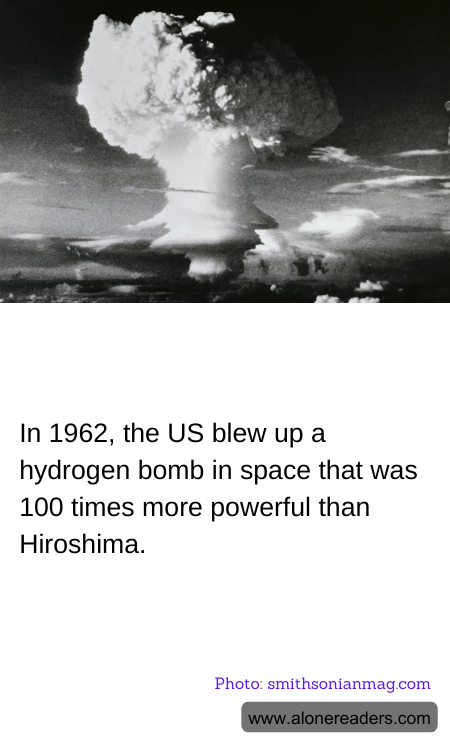
In 1962, during the height of the Cold War, the United States conducted a high-altitude nuclear test that remains one of the most powerful human-made explosions in space. This test, known as Starfish Prime, was part of a series called Operation Dominic and was executed on July 9, 1962. The hydrogen bomb detonated was indeed about 100 times more powerful than the atomic bomb dropped on Hiroshima in 1945, yielding an explosive power of approximately 1.4 megatons.
The test was conducted to gain a better understanding of the effects of nuclear blasts at high altitudes, primarily concerning their impact on communication and radar systems, which were thought to be potentially vulnerable in the event of nuclear war. The explosion took place 250 miles above the Pacific Ocean, just southwest of Johnston Island, from where the missile carrying the warhead was launched.
The detonation was spectacular and alarming. It illuminated the night sky, creating an artificial aurora that could be seen for thousands of miles. Residents of Hawaii, over 800 miles away, experienced a massive light show with eerie, multicolored effects. The electromagnetic pulse (EMP) generated by the explosion was far stronger than expected. It caused electrical damage in Hawaii, knocking out about 300 streetlights, setting off numerous burglar alarms, and damaging a telephone company microwave link, disrupting telephone service.
Starfish Prime was not only a display of the raw power of a hydrogen bomb but it also highlighted the vulnerability of modern electronic systems to EMP effects. The test led to significant advances in understanding the Earth's magnetic field and radiation belts, thanks to the artificial radiation belt formed by the released energetic particles, which lingered in the atmosphere for many weeks.
The scientific data gathered from this and other high-altitude tests were crucial in the development of strategies to protect vital military and civilian electronic infrastructure against EMP disruptions. However, the spectacle and unforeseen consequences of the Starfish Prime test also raised public awareness about the potential environmental and technical impacts of nuclear weapons testing, contributing to the growing anti-nuclear weapons movement of the time.
This moment in history underscored the profound and wide-reaching implications of nuclear arms, influencing treaties and international policies concerning the conduct of nuclear tests, including the Partial Nuclear Test Ban Treaty signed in 1963, which prohibited all test detonations of nuclear weapons except for those conducted underground. As such, Starfish Prime stands as a stark reminder of both the technical achievements and the perilous power of the nuclear age.
