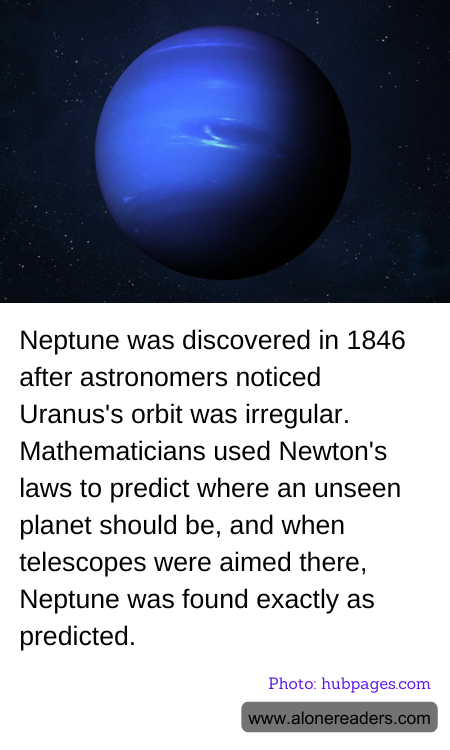
The discovery of Neptune in 1846 stands as a remarkable achievement in astronomical science, primarily driven by the quest to understand irregularities observed in the orbit of Uranus. Following its discovery in 1781, Uranus’s trajectory showed deviations from predictions based on Newtonian mechanics. This perplexing observation suggested that another, yet unseen, force was exerting an influence, possibly another planet’s gravitational pull.
Two mathematicians, John Couch Adams of Britain and Urbain Le Verrier of France, independently tackled this celestial puzzle. They applied Newton’s laws of motion and universal gravitation to calculate the position of the hypothesized planet that could account for the gravitational forces impacting Uranus’s orbit. Both arrived at similar predictions about the possible location of this new planet, providing astronomers with a targeted region of the night sky to examine.
The verification of Adams's and Le Verrier's predictions came with the direct observation of Neptune. On September 23, 1846, Johann Gottfried Galle, assisted by Heinrich d’Arrest at the Berlin Observatory, located Neptune almost exactly where it was predicted it would be, only about one degree off Le Verrier’s calculations. This discovery not only testified to the robustness of Newtonian physics but also marked the first time a celestial body was discovered through mathematical prediction rather than through regular observational astronomy.
Neptune’s discovery significantly impacted the scientific community, providing concrete evidence of the predictive power of mathematics when combined with physical laws. It also introduced a new member to the family of known planets in our solar system, leading to further studies about its composition, orbit, and potential moons. Over the years, Neptune has been observed extensively by telescopes and spacecraft, including the Voyager 2 flyby in 1989, which provided unprecedented data and images of the distant planet and its moons.
Reflecting on this fascinating journey—from theoretical calculations to actual discovery—Neptune’s finding highlights an extraordinary moment when science, mathematics, and observational astronomy intersected to expand our understanding of the universe.
