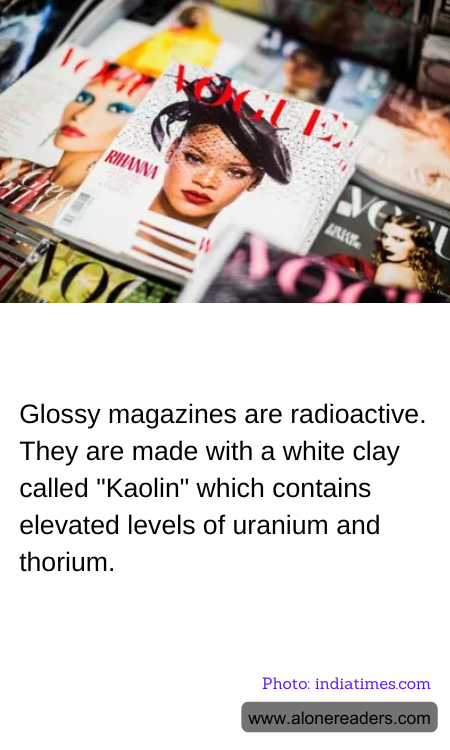
The claim that glossy magazines are radioactive because they are made with kaolin, a white clay purportedly containing elevated levels of uranium and thorium, is a fascinating topic that blends elements of truth with a touch of misunderstanding. Kaolin itself is indeed used in the production of glossy magazine paper. Known for its fine, white color, smooth texture, and chemical inertness, kaolin is a key component of the coating applied to this type of paper to give it a glossier appearance. However, the assertion about its radioactivity requires context.
Firstly, it's important to understand that kaolin is a type of clay made up predominantly of the mineral kaolinite. This mineral, like many natural substances, can contain trace amounts of naturally occurring radioactive materials (NORMs), such as isotopes of uranium and thorium. The presence of these radioactive elements is typical of many soils and clays worldwide, due not to contamination but to natural geological processes.
The key question revolves around the level of uranium and thorium in kaolin. Research indicates that while kaolin, like many clays, can indeed contain these elements, their concentrations are generally low and are comparable to many other naturally occurring materials. The levels found in kaolin are typically far below thresholds that would pose health risks to humans. In the context of glossy magazines, the process of refining and processing kaolin into a state suitable for magazine coatings likely reduces any trace radioactive elements even further.
Furthermore, the application of kaolin in magazine paper coating is quite minimal, and the barrier it forms on paper is extremely thin. Given this limited exposure, the notion that handling or reading glossy magazines results in significant radiation exposure is not supported by scientific evidence. The radiation levels from kaolin-containing magazine paper are negligible, especially when compared to other everyday sources of background radiation that people routinely encounter, such as radon in the air, cosmic radiation, or even the potassium-40 found in common foods like bananas.
Therefore, while the statement contains elements of scientific grounding regarding the composition of kaolin, the implications about the safety and radioactivity level of glossy magazines are largely overstated. Magazines, even those with the glossiest pages, do not present a health risk associated with radiation. As always, understanding the scale of exposure and the context of how materials are used provides important clarity in assessing potential health risks.
